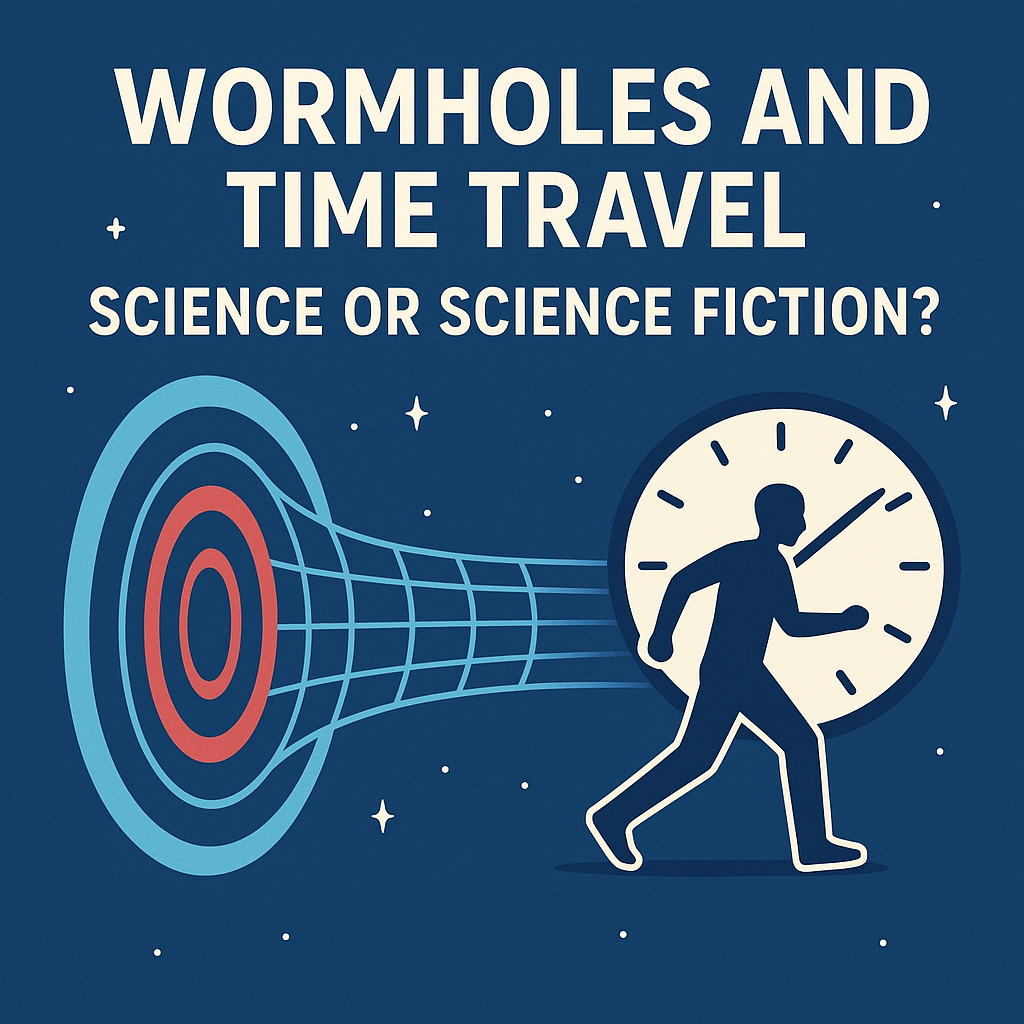
Wormholes and Time Travel: Science or Science Fiction?
Wormholes have captured the human imagination for decades—appearing in classic science fiction, inspiring movies and TV shows, and fueling real-world curiosity about whether spacetime could be engineered to “shortcut” the universe. But when the conversation turns to time travel, things get complicated fast. Are wormholes merely a storytelling device, or could they represent something more than fantasy?In this post, we’ll explore what science says about wormholes, what science struggles to confirm, and why time travel remains controversial. We’ll also look at adjacent concepts—like black holes, cosmic censorship, closed timelike curves, energy conditions, and quantum effects—to understand why wormholes are both exciting and difficult.
What Exactly Is a Wormhole?
A wormhole is a hypothetical “tunnel” in spacetime that could connect two distant regions of the universe—or even two different universes. Instead of traveling through normal space, an object could theoretically pass through this tunnel and emerge somewhere else.In everyday terms, imagine spacetime as a fabric. A wormhole would be a folded shortcut through that fabric: instead of traveling the long way around, you pass through the fold and reach your destination quickly.Mathematically, wormholes are solutions to Einstein’s equations of general relativity. That doesn’t automatically mean they exist in nature, but it does mean that—within the logic of known physics—spacetime can, in principle, be shaped to support them.
The Einstein-Rosen Bridge: A Classic Starting Point
One of the earliest wormhole ideas comes from work by physicists Einstein and Rosen. Their “Einstein-Rosen bridge” describes a geometry that resembles a wormhole connecting two regions. However, there’s a major catch: the bridge is not traversable in the way science fiction often portrays.In many formulations, the wormhole would pinch off too quickly or act like a non-traversable shortcut. In other words, the bridge might exist as a mathematical structure, but it wouldn’t allow a traveler to pass through safely.
Traversable Wormholes: The Sci-Fi Leap That Demands Physics
For time travel to enter the picture, you generally need a traversable wormhole—something you could actually enter and exit. A key milestone in modern wormhole discussions was the work of theorists including Kip Thorne and Morris (and collaborators), who developed conditions under which a wormhole might be traversable.The concept required a feature that immediately raises eyebrows: “exotic matter.” In simplified terms, exotic matter would have properties that violate (or circumvent) the usual energy conditions in general relativity.Energy conditions are like basic “rules” that help ensure gravity behaves in familiar ways. Violating them is not impossible in mathematical terms, but it is extremely difficult to confirm physically. Exotic matter is one of the biggest obstacles between wormhole theory and real-world plausibility.
Why Exotic Matter Matters
To keep a wormhole throat open long enough for travel, spacetime must be held in a configuration that resists collapse. In many wormhole models, this stability requires matter with unusual stress-energy characteristics—often described as negative energy density or negative pressure.In quantum physics, “negative energy” isn’t completely out of the question. Certain effects (like the Casimir effect) suggest that quantum fields can produce measurable negative energy densities under specific circumstances.But here’s the problem: the amounts needed for macroscopic, traversable wormholes appear wildly larger than what current experiments can produce. So while quantum theory offers tantalizing hints, it doesn’t yet provide a realistic recipe for building a wormhole.
Time Travel Enters: What Would Make It Possible?
Time travel is not just “going faster” or “skipping ahead” in a practical sense. In physics discussions, it usually means one of two things:
Time dilation: traveling in a way that time passes slower for you (and faster relative to others). This is real and measurable.
Going backward in time: creating conditions where cause and effect could loop, often associated with closed timelike curves (CTCs).
Most science fiction focuses on backward time travel, but that version is the most controversial. For wormholes, backward time travel becomes plausible (at least mathematically) when the geometry allows paths through spacetime that loop back on themselves.
Closed Timelike Curves (CTCs): The Heart of the Problem
In general relativity, a “timelike path” is a possible route a massive object could take through spacetime. A closed timelike curve would be a path that returns to the same spacetime point—meaning you could, in theory, revisit your own past.Some wormhole configurations—especially those involving moving mouths of the wormhole or strong gravitational fields—may create CTCs. In other words, a wormhole could become a “time machine” if its two ends are arranged so that traversing from one mouth to the other effectively reverses time ordering.This is where the phrase “science vs science fiction” really matters, because CTCs aren’t just a cool plot device—they raise deep questions about whether nature actually permits them.
The Novikov Self-Consistency Principle
One way physicists try to rescue time travel from paradoxes (like the classic “kill your grandfather” scenario) is through the Novikov self-consistency principle. This idea proposes that if CTCs exist, then only self-consistent histories are allowed.Translated: you can’t create contradictions. If you travel back in time, your actions would be constrained so that the timeline remains logically consistent.That doesn’t make time travel easy, but it offers a possible mechanism that prevents paradoxes—at least within the framework of certain theories.
Hawking’s Chronology Protection Conjecture
Another major viewpoint comes from Stephen Hawking. Hawking proposed the “chronology protection conjecture,” suggesting that the laws of physics prevent the formation of CTCs in the real universe.In spirit, it’s a cosmic safety system: if conditions begin to form that would allow backward time travel, quantum effects or other mechanisms might destabilize the spacetime geometry before a CTC can fully emerge.This is not a proven theorem, but it has influenced a lot of thinking about why time travel might be forbidden—or at least extremely constrained—in the physical world.
Wormholes, Black Holes, and the Misconceptions
Wormholes often appear in the same conversation as black holes. That’s because both involve extreme spacetime curvature. But wormholes are not simply “portals inside black holes.”Some models connect the inside of a black hole to another region of spacetime, but these connections typically lead to non-traversable structures. Additionally, black hole interiors are expected to be radically unstable depending on conditions, and our ability to analyze them may be limited.A common misconception is that “anything interesting near a black hole implies you can travel through time.” In reality, physics gets very subtle, and many hypothetical wormhole scenarios require conditions that are not supported by observational evidence.
Does Relativity Allow Time Travel in Practice?
General relativity permits many solutions that look like they could enable time travel. But theoretical permission does not equal physical permission. The gap between mathematics and reality is where science fiction usually runs free.To move from “allowed by equations” to “allowed by nature,” physicists ask whether the required matter, energy distributions, and quantum behavior are physically realizable. For most time travel via wormholes, the requirements are currently unknown or seem implausible.
Quantum Gravity: The Missing Ingredient
One reason time travel through wormholes remains unsettled is that our best theories conflict at extreme scales. General relativity describes gravity and spacetime structure extremely well, but quantum mechanics describes the behavior of matter and energy at small scales.At the “wormhole throat” level—where curvature could be enormous—quantum gravity effects likely matter. We don’t yet have a complete, experimentally verified theory of quantum gravity. That leaves open the possibility that quantum effects change everything: maybe they prevent traversable wormholes, or maybe they alter CTC behavior.So while wormhole and time machine ideas come from general relativity, the final word could depend on quantum physics we don’t fully understand yet.
What Would Wormholes Look Like If They Existed?
One question that brings the debate down to Earth is: could we detect wormholes? If wormholes exist, they might leave observable signatures.Potential clues could include gravitational lensing anomalies—ways that light bends in unexpected patterns if spacetime has a tunnel-like geometry. Another possibility involves gravitational waves: mergers or interactions near a wormhole could produce distinctive waveforms compared to black hole models.That said, many proposed signatures are subtle and can be mimicked by other astrophysical phenomena. Detecting a wormhole would likely require careful analysis and strong evidence, not just a “cool pattern” in data.
Time Travel That’s Real: Time Dilation
If you’re looking for something science-based that feels like time travel, there’s a compelling answer: time dilation is real, measured, and widely used in technology.According to special and general relativity, time passes differently depending on relative velocity and gravitational potential. Astronauts traveling at high speeds experience slower time relative to people on Earth. Clocks closer to massive objects also run slower due to gravitational time dilation.Global Positioning System (GPS) satellites rely on relativistic corrections to stay accurate. Without accounting for these effects, GPS would gradually drift—so in a sense, satellites are a daily reminder that spacetime is not “one universal clock.”Time dilation isn’t the same as going backward in time, but it shows that relativistic “time travel” is not purely fictional. It’s more like a controllable bending of the timeline rather than a plot-driven portal to the past.
Science Fiction as a Laboratory for Ideas
Science fiction gets criticized for being speculative, but it also plays an important role in scientific thinking. Writers and filmmakers explore hypothetical technologies and consequences, which can help scientists and engineers think through what’s possible.Many real scientific debates began as imaginative questions: “Could humans travel at near-light speed?” “What happens if faster-than-light travel were possible?” “Do information and causality have deeper constraints?” Fiction can propose scenarios that later inspire formal theoretical work—or at least clarify what assumptions we want to test.Wormholes and time travel are perfect examples. Even if most wormhole time machines remain unlikely, the underlying questions drive research into quantum fields, gravitational stability, energy conditions, and the nature of causality.
Is Wormhole Time Travel Science or Science Fiction?
The most honest answer is: it’s a blend of both.Science provides the mathematical framework. General relativity allows wormhole-like geometries, and under certain assumptions, time-travel-like structures (CTCs) can appear.Science fiction fills the gaps in realism. To make wormholes traversable and stable long enough for time travel, we often require exotic matter and conditions we have not observed or engineered. Additionally, chronology protection ideas and quantum gravity uncertainties may prevent time machines from forming in the real universe.So the core distinction is not whether wormholes are “possible” in equations—they are. The distinction is whether nature permits them in practice.
The Bottom Line: A Universe With Rules We’re Still Learning
Wormholes are a powerful reminder that spacetime might be more dynamic than our everyday intuition suggests. If they exist, they could reshape how we think about distance, gravity, and information.Time travel is harder. The mathematics can hint at backward causality, but the physical world may refuse to cooperate—either due to instability, quantum effects, or deeper constraints we don’t yet fully understand.In the end, wormholes and time travel sit at a fascinating crossroads. They’re not just fantasy; they’re a serious set of questions sitting inside the laws of physics. Whether they belong in the universe or only in our stories may depend on advances in observational astronomy and the elusive theory of quantum gravity.If you enjoyed this topic, consider diving deeper into related areas like gravitational lensing, the physics of black hole interiors, Casimir-like negative energy experiments, and the ongoing research into quantum gravity. The closer science gets to answering these questions, the more likely it is that future “science fiction” will become science—or that we’ll learn why some doors, even in principle, should never open.