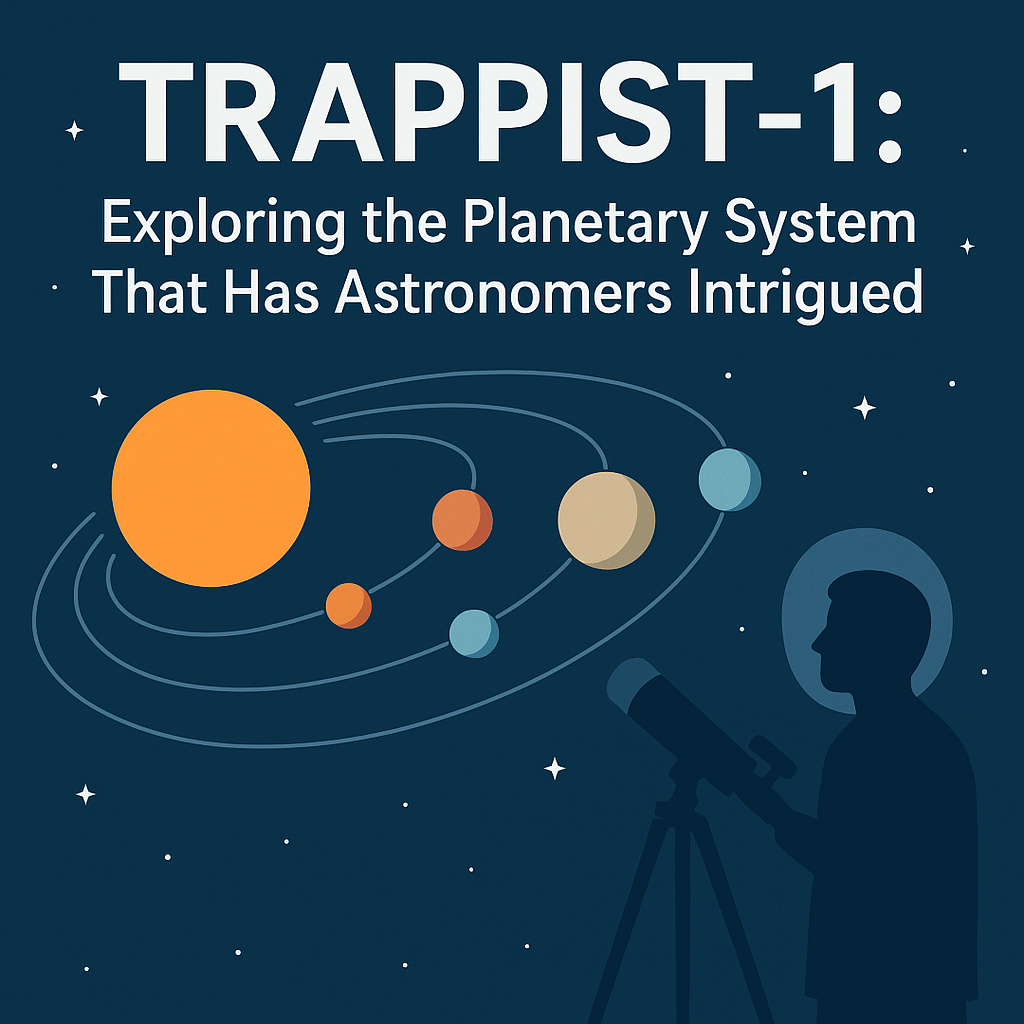
TRAPPIST-1: Exploring the Planetary System That Has Astronomers Intrigued
Some planetary systems feel like they’re built for imagination: planets packed closely together, worlds orbiting a dim star, and the tantalizing possibility that at least a few of those worlds might someday become targets for deeper searches. The TRAPPIST-1 system is exactly that kind of cosmic story. Since its discovery, TRAPPIST-1 has become one of the most studied planetary systems in the sky, and for good reason. It hosts multiple Earth-sized planets, many of which orbit in the star’s habitable zone—an area where liquid water might exist on a planet’s surface under the right conditions.In this article, we’ll explore what makes TRAPPIST-1 so fascinating, what astronomers have learned so far, why it’s such a hot topic in exoplanet research, and what the future may reveal as new telescopes and instruments come online.
What Is TRAPPIST-1?
TRAPPIST-1 is a nearby red dwarf star—specifically, an ultra-cool M dwarf—located about 40 light-years away in the constellation Aquarius. The star’s name comes from the TRansiting Planets and PlanetesImals Small Telescope (TRAPPIST) in Chile, which helped detect the system’s planets using the transit method.At first glance, a small, dim star might not sound spectacular. But red dwarfs like TRAPPIST-1 are crucial in exoplanet science because they’re relatively small and cool. That means that when planets pass in front of the star (from our point of view), the drop in brightness is easier to measure than it would be for a larger, hotter star. In other words, TRAPPIST-1 is like a cosmic “spotlight” that helps astronomers detect tiny planetary signals.
The Discovery: A System with Many Planets—One Star
In 2016, astronomers studying TRAPPIST-1 reported the presence of multiple planets. This was immediately exciting because it wasn’t just one or two worlds—it appeared to be a whole family of planets. Later observations refined the counts and confirmed seven Earth-sized planets orbiting TRAPPIST-1, each designated with letters: b, c, d, e, f, g, and h.What makes this even more remarkable is that these planets orbit very close to their star. Their orbital periods range from just a few days to a little over a dozen days. Despite the closeness, several of them fall into the star’s habitable zone, making them prime candidates for future studies of atmospheres and potential habitability.
TRAPPIST-1’s Planet Lineup: Earth-Sized and Close to the Action
Here’s a simplified overview of why the TRAPPIST-1 planets matter. The planets are roughly Earth-sized (some may be slightly larger) and follow a compact orbital arrangement. Some of these planets are considered within the habitable zone:
TRAPPIST-1e and TRAPPIST-1f: Often discussed as potentially within the habitable zone.
TRAPPIST-1g: Frequently also discussed as possibly within or near the habitable zone, depending on modeling assumptions.
TRAPPIST-1d and TRAPPIST-1h: These are important too, but their temperatures and conditions may differ more strongly from habitable-zone estimates.
While orbital location is a key factor, habitability is complex. A planet’s ability to support liquid water depends on atmospheric composition, pressure, magnetic protection, internal heat, and how much energy it receives over time—especially from a dynamic red dwarf.
The Transit Method: How Astronomers “See” These Worlds
TRAPPIST-1 became famous through the transit method. When a planet moves between us and its star, it blocks a small fraction of the starlight. This creates a periodic dip in the star’s brightness. By measuring those dips, astronomers can infer:
Planet size (how much light is blocked)
Orbital period (how often transits occur)
Potential atmospheric signatures (if the planet passes in front of the star while starlight filters through the atmosphere)
For a compact system like TRAPPIST-1, transits can happen frequently across multiple planets. That increases opportunities to gather data—and to compare how planets behave under similar stellar conditions.
Why a Red Dwarf Matters: Benefits and Challenges
Red dwarfs are a major focus in exoplanet research, but they come with both exciting advantages and serious challenges.
Advantages
Because red dwarfs are smaller and cooler, the contrast between the planet and the star is more favorable for detecting transits. Also, red dwarfs can remain stable long enough for repeated observations.
Challenges
Red dwarfs can be active. They may emit powerful stellar flares and strong stellar winds. For planets orbiting close in, this raises questions about whether an atmosphere can survive. High-energy radiation could strip away lighter gases or alter atmospheric chemistry over time.In the TRAPPIST-1 system, the planet candidates likely experience intense stellar activity—especially those closer to the star. That doesn’t automatically rule out habitability, but it means scientists need to study atmospheres carefully and model how planets might respond to their environment.
Mass, Density, and What They Might Tell Us
Transit observations tell us about planet size, but not everything. To understand what those planets might be made of, astronomers also measure mass, often using the gravitational influence planets have on each other or on the star.With both mass and radius, researchers can estimate planet density, which can provide clues about composition. A rocky planet with an iron core and silicate mantle will have a different density than a planet dominated by water or volatiles. That’s where TRAPPIST-1 becomes especially valuable: because it has multiple planets, scientists can compare outcomes across different orbital distances and likely formation histories.The TRAPPIST-1 planets are generally thought to be at least partly rocky, though the degree of possible volatile content—such as water-rich layers—remains an active topic of research.
Habitability: Could Any of TRAPPIST-1’s Planets Be Like Earth?
The phrase “habitable zone” is often used in exoplanet discussions, but it’s not a guarantee of life. For TRAPPIST-1, habitability assessments involve several layers:
Stellar energy: Are the planets receiving the right amount of heat?
Atmospheric conditions: Could the planet retain an atmosphere?
Surface water potential: Might water exist as a liquid?
Climate stability: Could temperatures remain suitable over time?
Tidal locking and rotation: Close-in planets may have slower rotation or synchronous rotation, affecting weather patterns.
Stellar activity exposure: Flares could affect the chemistry and survival of atmospheres.
Because TRAPPIST-1’s planets are relatively close together, they also experience strong gravitational interactions. These interactions can affect orbital eccentricity, internal heating, and long-term climate cycles—again, all crucial factors for potential habitability.
Atmosphere Studies: The Next Big Step
One reason TRAPPIST-1 continues to captivate scientists is that it’s an ideal target for atmospheric characterization. If astronomers can detect the atmosphere’s composition—such as water vapor, carbon dioxide, methane, or other gases—they can better estimate whether a planet could support life as we understand it.The upcoming and ongoing era of space telescopes is tailored for exactly this goal. Observatories can attempt to capture how a planet’s transit signal changes at different wavelengths, a technique known as spectroscopy. Different gases absorb light differently, leaving distinct fingerprints. Detecting those fingerprints is challenging, especially for smaller planets, but TRAPPIST-1’s favorable geometry and repeated transits make it a strong candidate.Scientists are also interested in the possibility of clouds and hazes. These can obscure atmospheric signals, but they also reveal how atmospheres process energy. In other words, even “negative” results can teach us something valuable about planetary environments.
Beyond Habitability: The Science of Planet Formation
TRAPPIST-1 isn’t just a “life search” story. It’s also a planet formation puzzle. How does a system produce multiple Earth-sized planets in such tight orbits around a small star? Several theories exist:
Planet migration: Planets may form farther out and move inward as the disk of gas dissipates.
Resonant orbital architecture: The planets’ gravitational relationships may indicate a history of migration and orbital trapping.
Compositional gradients: The material available at different distances in the early protoplanetary disk can shape planets’ final compositions.
As more observations refine orbital parameters and planet properties, TRAPPIST-1 provides a natural laboratory for studying how compact planetary systems evolve.
What Makes TRAPPIST-1 a Standout in the Exoplanet Era?
There are many exoplanets and many systems with multiple planets. So why does TRAPPIST-1 stand out? The answer is a combination of factors:
Multiple Earth-sized worlds: It’s not just gas giants far away—it’s a set of rocky candidates.
Frequent transits: The geometry allows repeated observations.
Proximity: At about 40 light-years away, it’s relatively near on cosmic scales.
Atmospheric potential: Scientists can aim for spectroscopy to test atmospheric composition.
Rich modeling opportunities: The system’s dynamics provide constraints on how it formed and how it evolves.
In short, TRAPPIST-1 offers both observational accessibility and scientific depth. It’s a system where astronomers can combine data with theory to answer multiple questions at once.
The Future of TRAPPIST-1 Research
Astronomy is moving into a phase where small, rocky exoplanets are increasingly within reach. TRAPPIST-1 will likely remain a central target as scientists improve measurement precision and gather more data. Future work may include:
Refined planet masses and densities to better constrain composition
Atmospheric detections or improved upper limits on atmospheric content
Monitoring stellar activity to understand how flares influence planetary environments
Climate and evolution modeling that includes atmospheric loss, tidal effects, and radiation histories
Even if life is not found soon, systems like TRAPPIST-1 push the boundary of what we can measure. They help scientists learn how common Earth-like planets might be and what conditions are typical around red dwarfs.
Conclusion: A Star System Worth Watching
TRAPPIST-1 is more than a list of seven planet names. It’s a dynamic, compact planetary system that has become a cornerstone of modern exoplanet research. Its Earth-sized worlds, their proximity to the habitable zone, and their accessibility to transit-based observations make it an ideal place to test theories about planetary atmospheres, composition, and habitability.As telescopes grow more powerful and detection methods improve, the TRAPPIST-1 system may shift from “intriguing candidates” to “measured worlds”—with atmospheres characterized and compositions better understood. For now, it remains one of the most captivating corners of the galaxy, inviting astronomers to keep looking, keep modeling, and keep asking what might be possible around a small red star in Aquarius.Stay curious—because the next discovery in the TRAPPIST-1 story could be only a transit away.