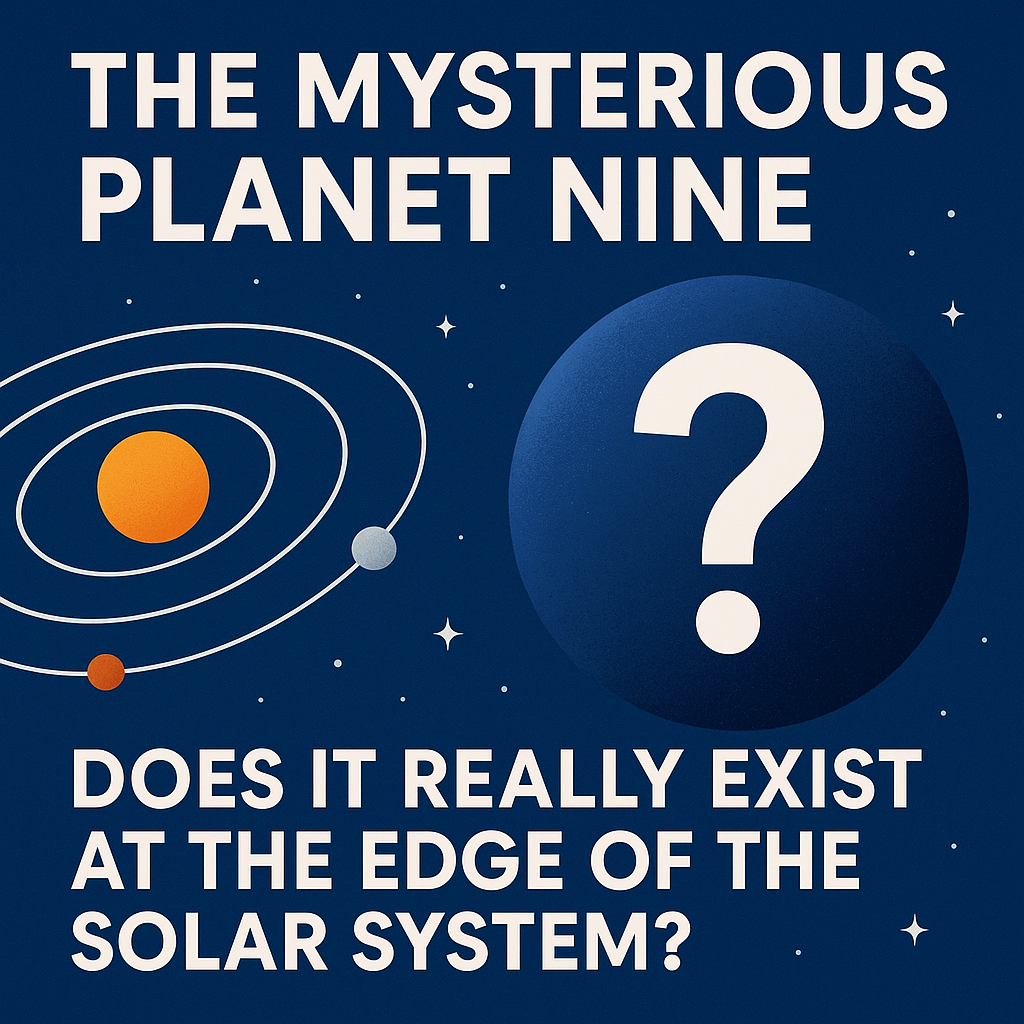
The Mysterious Planet Nine: Does It Really Exist at the Edge of the Solar System?
Somewhere beyond Neptune—far beyond the last planet most people can name from memory—there may be a ninth world shaping the outer Solar System in subtle, long-term ways. That hypothetical world is called Planet Nine. It’s a tantalizing idea: a cold, distant planet wandering in the dark, tugging on far-flung icy bodies and leaving behind patterns that could be hard to explain by chance.But is Planet Nine real? Or is it a scientific mirage—an interpretation that may disappear as better data arrives? In this post, we’ll explore what Planet Nine is, why astronomers think it might exist, what evidence has been proposed, and what alternative explanations scientists consider. We’ll also discuss why this search matters, how telescopes and data analysis work together, and what the future could reveal.
What Is Planet Nine?
Planet Nine is a proposed planet beyond Neptune, believed to orbit the Sun at a great distance. While the Solar System is officially known to contain eight planets, Planet Nine is not confirmed. It remains a hypothesis—an educated guess based on gravitational effects observed in the outer Solar System.In the most widely discussed version of the idea, Planet Nine would be a few times Earth’s mass, possibly with a highly stretched (elliptical) orbit. It’s expected to be extremely dim because it would be so far from the Sun and from Earth, making direct detection challenging.
Why Astronomers Started Talking About It
The outer Solar System is home to trans-Neptunian objects (TNOs)—icy bodies that orbit beyond Neptune. Many of these objects have highly eccentric and inclined orbits, and their paths can be influenced by the giant planets. However, over time, researchers noticed something peculiar: for a subset of distant TNOs, the objects seemed to share similar orbital characteristics more often than random chance would predict.In particular, scientists have pointed to possible clustering in the following orbital features:
Perihelion orientation (how the orbit’s closest approach to the Sun is oriented)
Orbital inclination and general alignment
Longitudes of orbital elements, such as the longitude of perihelion
If these distant objects really are clustering in a way that isn’t easily explained by known planets—or by observational bias—then a massive distant perturber could be the missing cause.
Indirect Evidence: How Would a Distant Planet Change Orbits?
To understand why scientists suspect Planet Nine, it helps to think in terms of gravity. A planet doesn’t just orbit the Sun; it also exerts gravitational influence that can reshape the orbits of smaller bodies over long periods. In the cold outskirts of the Solar System—where orbital periods can be thousands of years—these subtle effects can accumulate.Imagine a distant, massive planet tugging on icy objects in the Kuiper Belt and beyond. Over millions of years, that tug could shepherd some objects into orbital states that appear “coordinated” when observed from Earth. Even without seeing Planet Nine directly, its gravitational fingerprints could show up in the orbital patterns of other bodies.
The Leading Hypothesis and Its Proposed Parameters
The Planet Nine concept gained mainstream attention after researchers proposed that an unseen planet could explain the clustering among certain extreme TNOs. The hypothesis suggests Planet Nine might have:
A mass around 5 to 10 Earth masses (estimates vary)
An orbit with a very large semi-major axis (meaning it would be far from the Sun)
A significantly elliptical orbit
An orbital plane that could be tilted relative to the plane of the Solar System
These details matter because they determine what kinds of orbital alignments the hypothetical planet would produce. They also determine where astronomers might point their telescopes in the sky.
Observational Bias: Could the “Pattern” Be an Illusion?
Even if a distant planet exists, science requires caution. One of the biggest challenges in outer Solar System studies is that our surveys are not perfect. Telescopes have limited sky coverage, and objects are easier to detect in some regions than others. This leads to observational bias.So how do astronomers account for this? They model survey selection effects—essentially asking, “Given how we search, how likely is it that we would see this clustering if Planet Nine didn’t exist?”Some researchers argue that the clustering signals may be partially explained by biases or small sample sizes. Others counter that even after accounting for bias, the alignment remains difficult to explain without an additional gravitational influence.In short: Planet Nine is plausible, but not universally accepted as the only answer.
What Would Direct Detection Look Like?
Indirect evidence is useful, but confirmation would come from directly observing the planet—detecting a faint moving object that matches the predicted orbit. Direct detection is extraordinarily difficult because Planet Nine would be:
Very far from the Sun (and thus cold and dim)
Very far from Earth (low apparent brightness)
Likely slow-moving relative to background stars, requiring careful tracking
Because of these challenges, astronomers rely on large-area surveys, deep imaging, and sophisticated software to detect faint objects and link their motion across multiple nights.
Current Status: Signs, Surveys, and Uncertainty
Over the years, multiple teams have scanned the outer sky using modern survey telescopes. Each new dataset can strengthen or weaken the Planet Nine idea. The key questions scientists ask include:
Do the orbital clustering patterns persist as more TNOs are discovered?
Do improved models of observational bias reduce the apparent need for Planet Nine?
Do searches find a candidate planet consistent with predictions?
At the same time, new discoveries of distant objects can change the statistics. One or two additional extreme objects can shift the conclusions dramatically, especially when the sample is still small.
Alternative Explanations: If Not Planet Nine, Then What?
Planet Nine isn’t the only theory on the table. Several alternatives have been suggested, and they generally fall into categories related to dynamics and observational effects.
1) The Cluster Could Be a Selection Effect
As mentioned earlier, our surveys have uneven sensitivity. If most observed objects come from certain regions of the sky and certain ranges of distance or brightness, clustering might appear stronger than it truly is.
2) The Orbits Could Be Shaped by Known Planets and the Solar System’s History
Some models propose that the early Solar System—its migrations and gravitational interactions—could have thrown distant objects into unusual orbits. In such scenarios, you might not need a new planet; you’d need a better description of how the Solar System formed and evolved.
3) Stellar Encounters and Galactic Tides
On very long timescales, the gravity of passing stars and the overall influence of the Milky Way’s tidal field can affect distant bodies. These effects could also help explain parts of the observed orbital behavior, especially for objects at extreme distances.Ultimately, the scientific process means testing which hypothesis best fits the data with the fewest assumptions.
Why Planet Nine Matters—Even If It’s Not Found (Yet)
The search for Planet Nine is more than a scavenger hunt for a hypothetical planet. It drives progress in multiple areas:
Understanding Solar System dynamics: How gravity sculpts orbits over billions of years
Improving detection techniques: Better pipelines for finding faint, slow-moving objects
Refining statistical methods: More robust handling of observational bias
Mapping the outer Solar System: Discovering new TNOs and learning their distributions
Whether Planet Nine is confirmed, disproved, or replaced by another model, the journey improves our knowledge of how planetary systems evolve.
How Astronomers Search for Outer Solar System Worlds
Searching for something like Planet Nine requires a combination of strategy and technology. Here’s what the workflow typically looks like:
Deep Wide-Field Imaging
Large telescopes and wide-field cameras capture huge swaths of sky. Surveys can take many exposures per region, allowing astronomers to identify objects that move.
Motion Detection and Orbit Linking
When a candidate object appears in multiple images taken on different nights, software can estimate how fast it moves and in what direction. Then astronomers attempt to connect those measurements into a plausible orbit.
Filtering the Candidate List
Not every detection is a planet. Candidates can include near-Earth asteroids, main-belt objects, or distant galaxies. Astronomers apply criteria based on motion, brightness, color, and distance estimates.
Follow-Up Observations
If something seems promising, follow-up observations refine its orbit. Only with enough tracking can scientists determine whether it’s consistent with the expected characteristics of Planet Nine.
What If Planet Nine Is Confirmed?
If Planet Nine is eventually confirmed, it would be a major milestone. A ninth planet—especially one orbiting at extreme distances—would reshape how we think about the Solar System’s structure. It could also provide clues about the Solar System’s formation environment and early gravitational evolution.Moreover, discovering a distant, massive world would influence the search for other unseen objects and could lead to new predictions about where else astronomers might find “missing” components of the Solar System.
What If Planet Nine Isn’t There?
It’s equally important to consider the outcome where Planet Nine doesn’t exist. In that case, scientists would likely conclude that the orbital clustering signal can be explained by biases, small-number statistics, and/or alternative dynamical processes like stellar encounters, galactic tides, or early planetary migration.Even then, the research would not be wasted. It would still clarify which mechanisms dominate the shaping of distant TNO orbits and help refine models of the outer Solar System.
A Question Worth Watching: The Next Datasets
Science advances by accumulating evidence. The Planet Nine story will continue evolving as surveys discover more extreme TNOs, refine sky coverage models, and improve detection sensitivity. Future telescopes and deeper, wider surveys may dramatically increase the number of known distant objects—making statistics more robust and predictions more testable.And perhaps, one night, a faint point of light will move just enough across the background stars to reveal the presence of a planet we haven’t seen before.
Conclusion: Does Planet Nine Really Exist?
So, does Planet Nine really exist at the edge of the Solar System? As of today, it remains unconfirmed. The Planet Nine hypothesis is compelling because it offers a possible explanation for orbital clustering among some extreme trans-Neptunian objects. However, the evidence is not definitive, and alternative explanations—especially observational bias and different dynamical scenarios—are still actively debated.In other words: Planet Nine is a strong, testable hypothesis, not yet a proven reality. The mystery persists not because scientists lack imagination, but because confirmation requires careful observation, rigorous statistics, and direct evidence.The outer Solar System is still a frontier. And that’s exactly why the search for Planet Nine is so exciting: every new discovery not only brings us closer to answering one question, but also deepens our understanding of the cosmic neighborhood we call home.Want to learn more? Keep an eye on TNO discoveries and survey results—because the data you’ll read next could either tighten the case for Planet Nine or help close the door on it for good.