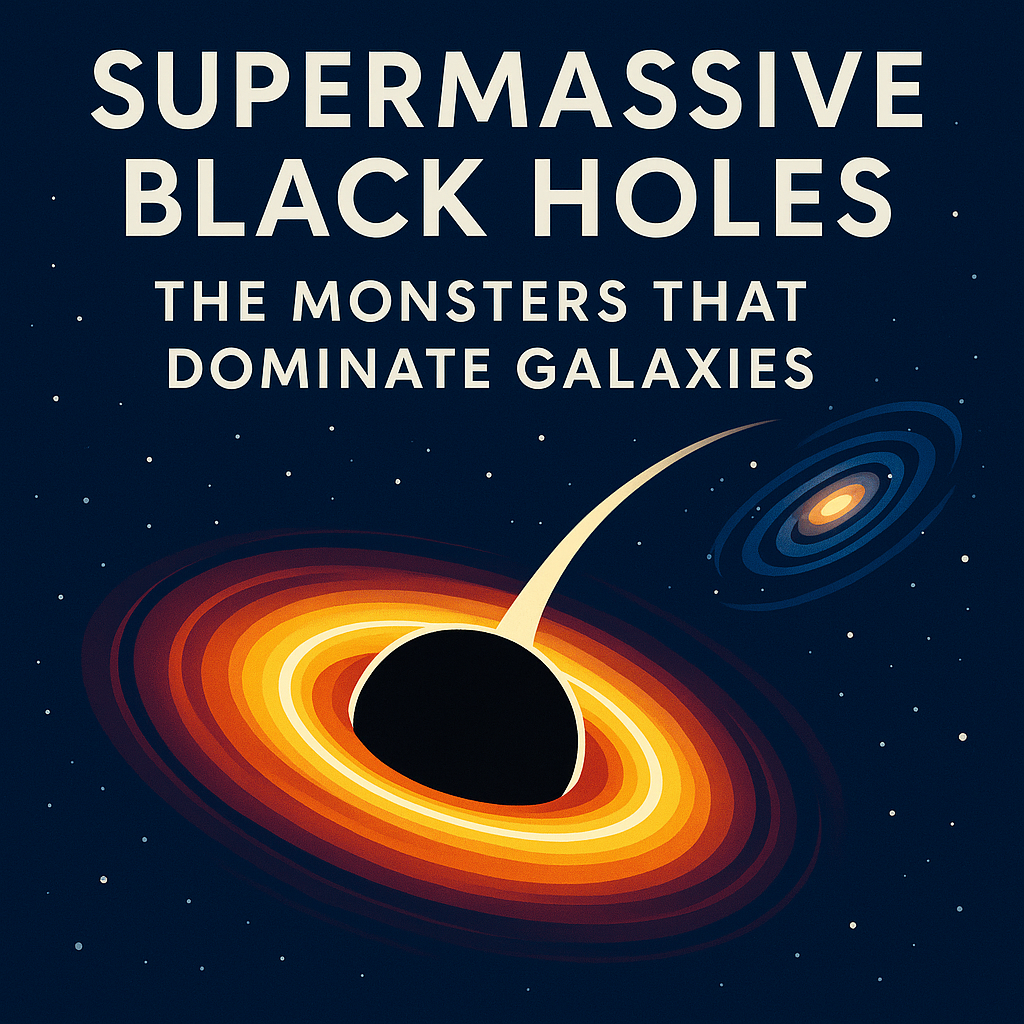
Supermassive Black Holes: The Monsters That Dominate Galaxies
In the center of many galaxies—spiral, elliptical, and irregular—there’s a presence so powerful it reshapes the fate of entire star systems. These objects are supermassive black holes: cosmic “monsters” that may sound like pure science fiction, yet they’re supported by overwhelming evidence from astronomy. They don’t just lurk quietly in galactic cores. They influence how galaxies form, how they grow, and even how their brightest features shine.But what exactly is a supermassive black hole? How do we know they’re there? And why do they seem to be so tightly linked to the galaxies they dominate? Let’s explore the dark giants that sit at the heart of the Universe.
What Is a Supermassive Black Hole?
A black hole is a region of space where gravity is so strong that not even light can escape once it crosses a boundary called the event horizon. A supermassive black hole is a black hole with a mass millions to billions of times greater than the Sun.To put that in perspective, consider that the Milky Way’s central black hole—Sagittarius A*—has a mass around 4 million Suns. That’s already enormous. But other galaxies host black holes hundreds of millions or billions of times the Sun’s mass, making them the dominant gravitational force at the center of their galaxies.These monsters are not “black” in the usual sense—they don’t emit light directly. Instead, their presence is revealed through the effects they have on surrounding matter: stars orbiting quickly near the center, gas heating up as it falls inward, and powerful energetic phenomena like quasars.
How Do We Know They Exist? The Evidence Behind the Darkness
You might think detecting an object that doesn’t emit light would be nearly impossible. Yet astronomers have developed multiple methods to infer supermassive black holes’ existence. Here are some of the most convincing lines of evidence.
1. Stellar Orbits Near the Galactic Center
In our own galaxy, astronomers tracked stars moving close to Sagittarius A*. These stars travel at astonishing speeds—thousands of kilometers per second—because they’re orbiting something with an immense mass concentrated in a tiny region.In 1992, observations began to show this pattern clearly. Over the years, measurements improved dramatically, allowing astronomers to conclude that the only plausible explanation is a supermassive black hole at the center of the Milky Way.
2. Hot Gas and Accretion Disks
When matter spirals toward a black hole, it often forms a structure called an accretion disk. Friction and gravity heat this disk to extreme temperatures, making it glow in X-rays, ultraviolet light, and other wavelengths.As gas gets pulled in, it can also produce jets—narrow streams of charged particles moving near the speed of light. These jets can extend thousands of light-years, blasting energy far beyond the black hole’s immediate environment.
3. Active Galactic Nuclei and Quasars
Some supermassive black holes are especially “active.” When large amounts of gas fall into them, they ignite the region around them, creating an active galactic nucleus (AGN). The brightest AGNs observed at vast distances are called quasars.Quasars can outshine the entire galaxy hosting them, powered by the energy released as matter accretes. Their luminosity provides strong evidence that something extremely massive is at work in the galaxy center.
4. Gravitational Lensing and Event Horizon Imaging
Supermassive black holes can bend light due to gravity. Astronomers observe these effects through techniques like gravitational lensing, which helps infer the mass distribution of the central object.Additionally, projects like the Event Horizon Telescope have produced groundbreaking images of the black hole’s immediate surroundings. While black holes themselves aren’t directly visible, the observed “shadow” and surrounding emission patterns match predictions from Einstein’s theory of general relativity.
Where Do Supermassive Black Holes Come From?
One of the biggest mysteries in astrophysics is how supermassive black holes formed so early in cosmic history. The Universe is about 13.8 billion years old, and yet quasars—powered by supermassive black holes—are seen at distances indicating they existed when the Universe was much younger.Scientists propose several scenarios:
Seed black holes form from the first generation of stars or from direct collapse of gas.
Black holes grow through accretion, steadily consuming gas over time.
They can also grow during galaxy mergers, when black holes collide or merge after their host galaxies merge.
Even with these theories, the speed of growth required to reach billions of solar masses quickly remains a challenge. That’s why researchers continue to test ideas using observations of early galaxies, black hole demographics, and computer simulations.
How Black Holes Dominate Galaxies (Even Without “Eating” Them)
Despite their reputation, supermassive black holes don’t necessarily consume entire galaxies. Many galaxies host black holes that are relatively quiet—dormant or only lightly accreting matter. Yet black holes still influence galaxy behavior dramatically.
Gravity: The Invisible Architect
At the center, a supermassive black hole’s gravity pulls in stars and gas. This affects:
The motion of stars near the galactic core
The distribution of gas in the central regions
The rate at which new stars can form
Feedback: The Cosmic “Brake” and “Gas Pedal”
One of the most important ways black holes influence galaxies is through feedback. When matter accretes, it releases energy that can heat surrounding gas or push it outward, making it harder for gas to cool and form new stars.At the same time, black holes can sometimes compress gas in certain regions, potentially triggering star formation. The overall impact can depend on the environment and the black hole’s activity level.
Relating Black Holes and Bulges: A Tight Cosmic Connection
A striking observation is that supermassive black holes correlate with the properties of their host galaxies, particularly the bulge—the central, more spheroidal region.For example, there’s a well-known relationship between black hole mass and the velocity dispersion of stars in the bulge. In simpler terms: the way stars move in a galaxy’s core seems linked to the mass of the central black hole.This suggests that black hole growth and galaxy evolution are intertwined, likely influenced by the same processes: gas supply, mergers, and energetic feedback.
The Accretion Disk: Where Matter Glows Into the Abyss
If you want to understand what makes supermassive black holes “visible,” look at accretion disks.As gas falls toward the black hole, it doesn’t spiral straight in. Instead, it forms a disk because of its angular momentum. Friction within the disk heats it to extreme temperatures, producing radiation across the electromagnetic spectrum.In many active galaxies, the hottest inner regions of the accretion disk emit strongly in ultraviolet and X-ray bands. Observations in these wavelengths help astronomers estimate accretion rates and black hole properties.Meanwhile, the outer regions of the disk may emit optical and infrared light. This layered “glow” is a key reason why astronomers can study black holes indirectly, even when the black hole itself remains invisible.
Jets and Relativistic Outflows: The Black Hole’s Megaphone
Some supermassive black holes produce powerful jets that can stretch far beyond the host galaxy. These jets carry energy away from the central region, affecting the interstellar medium.While the exact details of jet formation are still under active investigation, many models suggest a connection to magnetic fields and the spin of the black hole. When conditions are right, magnetic processes can launch and accelerate particles along the black hole’s rotation axis.The presence or absence of jets may help explain why some active galaxies dramatically suppress star formation, while others behave differently.
Why Supermassive Black Holes Matter for Cosmology
Supermassive black holes aren’t just interesting objects in galactic centers—they’re also central to big questions about the Universe.
Galaxy evolution: Black holes help regulate how galaxies grow and form stars.
Early Universe research: Finding supermassive black holes at high redshifts helps probe the first billion years of cosmic history.
Testing gravity: Black hole environments provide extreme conditions for testing Einstein’s theory of general relativity.
Measuring cosmic structure: Observations of AGNs and their energy output help map matter distribution across space.
In short, these cosmic monsters are also cosmic tools.
Myth vs. Reality: Debunking Common Black Hole Misconceptions
Black holes attract plenty of misconceptions—some from pop culture, some from oversimplified explanations. Here are a few clarifications.
“Black Holes Suck Everything In”
Not exactly. A black hole’s influence is significant only close to it. Far away, its gravity behaves like that of any other massive object. Black holes don’t automatically “vacuum” nearby planets or stars.
“You’d Be Spaghettified Instantly”
This can happen in certain situations, but it’s not a universal immediate effect. Whether and how tidal forces stretch you depends on your distance from the black hole. Also, we have no direct human experience to confirm details.
“They Are Totally Dark”
Black holes themselves don’t emit light, but their surroundings often do—especially accretion disks and jets. That’s why black holes are observable indirectly.
What Are Astronomers Doing Now? The Future of Black Hole Research
The study of supermassive black holes is rapidly advancing. Ongoing and planned observatories aim to improve resolution, sensitivity, and coverage across wavelengths.In particular, astronomers are working on:
More detailed imaging of black hole environments
Measuring black hole spins and accretion properties
Tracking how active galaxies evolve over time
Discovering more black holes in early galaxies
Connecting black hole growth with star formation history
As technology improves, the “monster in the center” becomes less of a mysterious rumor and more of a detailed, measurable part of cosmic history.
Conclusion: The Monsters That Shape the Universe
Supermassive black holes are among the most extreme objects known—yet they are also fundamental players in the story of galaxies. They may be invisible at first glance, but their influence is written across orbital motions, glowing accretion disks, powerful jets, and the remarkable relationship between black holes and galactic bulges.These monsters don’t just dominate galaxies through raw gravity. They can steer evolution using energy feedback and help determine whether galaxies continue forming stars or quiet down. In a cosmic sense, they act like both engines and regulators—an unusual combination that makes them central to understanding how the Universe evolves.So the next time you picture a galaxy, imagine its heart: a dark, massive presence that—despite the name—doesn’t merely destroy. It transforms, organizes, and sometimes even energizes the vast systems around it. In the cosmic theater, supermassive black holes are the looming directors.