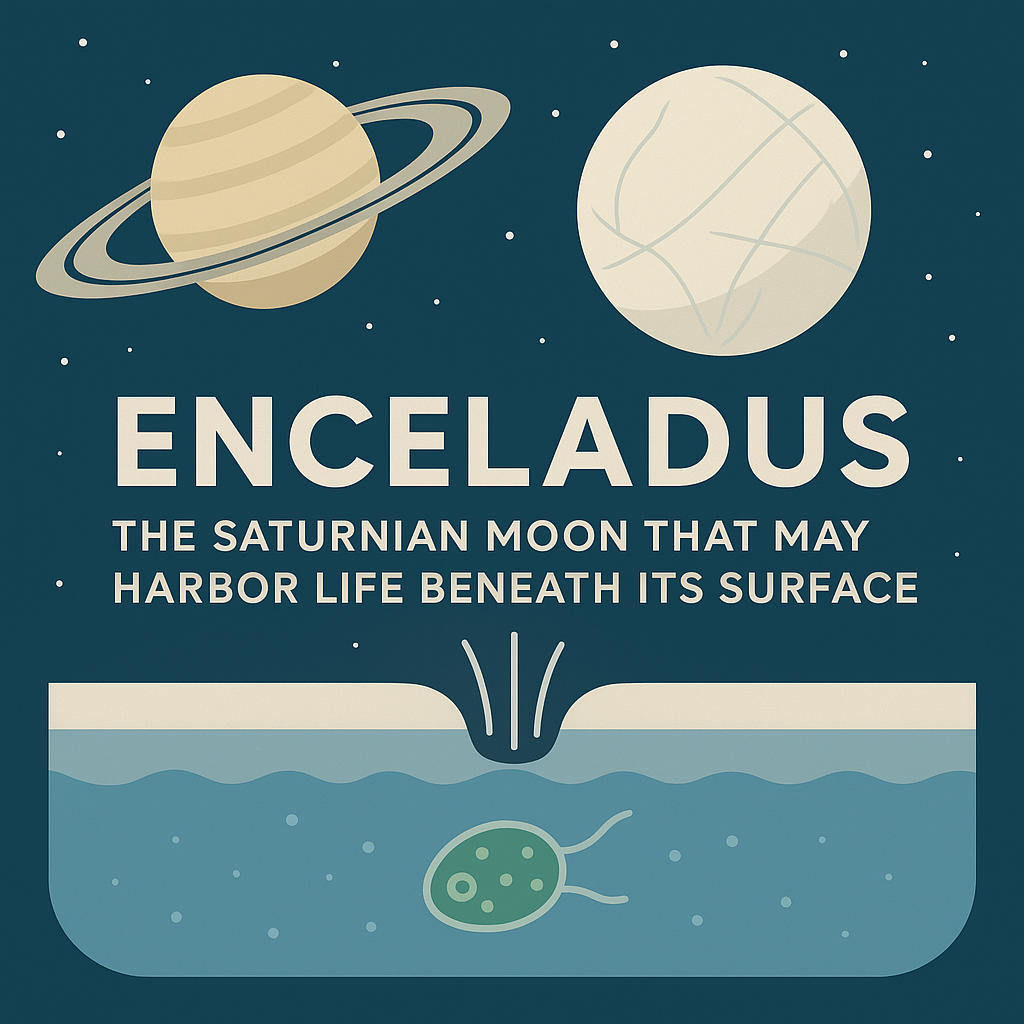
Enceladus: The Saturnian Moon That May Harbor Life Beneath Its Surface
Saturn is already a spectacle in our solar system—ringed, distant, majestic. But one moon of Saturn has captured the imagination of scientists and the public alike: Enceladus. Though it is small on a cosmic scale, Enceladus stands out as one of the most promising places to search for life beyond Earth. Why? Because beneath its icy shell, this moon appears to have the ingredients—and possibly the energy—needed to support microbial life. Even more compelling: Enceladus actively vents water vapor and ice from its south polar region, offering a rare chance to study a potentially “habitable” ocean without drilling through kilometers of ice.In this post, we’ll explore what makes Enceladus special, what scientists have discovered so far, how life could potentially exist there, and why studying it matters for future missions. Along the way, we’ll also touch on related themes like astrobiology, ocean worlds, cryovolcanism, and the ongoing search for biosignatures.
Meet Enceladus: Saturn’s Small Moon With a Big Secret
Enceladus is about 500 kilometers (310 miles) across—roughly the size of parts of a mid-sized moon, but tiny compared to Saturn itself or Earth. It orbits within Saturn’s E-ring region and is one of the system’s brightest objects because of its highly reflective ice. At first glance, Enceladus looks like a frozen world: a cold sphere covered in snow-like water ice.However, the surface tells only half the story. The key mystery is what lies underneath. Many celestial bodies in the outer solar system likely contain subsurface oceans due to tidal heating—where gravity from a larger planet or moon flexes the interior and generates heat. Enceladus appears to be a standout example, with strong evidence for a global or near-global ocean beneath an ice shell.
The South Pole “Tiger Stripes” and Active Plumes
The breakthrough came with NASA’s Cassini spacecraft, which orbited Saturn from 2004 to 2017. Cassini’s instruments detected a remarkable phenomenon: at Enceladus’s south pole, there are long, narrow fractures nicknamed the “tiger stripes.” These features aren’t just geological scars—they are vents.When Cassini flew through these plumes, it found evidence of water vapor, ice particles, and organic molecules. The moon was actively releasing material from its interior into space. In other words, Enceladus wasn’t merely a frozen relic—it was dynamic, continuously resurfacing, and exchanging material between its ocean and the outer solar system.These observations are critical for astrobiology. If a subsurface ocean exists and interacts with rocks below, then chemical reactions could provide both nutrients and energy for potential life. And if plumes carry samples from that ocean upward, scientists can analyze them remotely, improving the odds of detecting chemical hints of biology.
Evidence for a Subsurface Ocean
What convinces researchers that Enceladus has an ocean beneath its icy surface? Multiple lines of evidence converge:1) Heat and geysers: The south polar region is unusually warm compared to what sunlight alone can explain. Cassini measured thermal emissions consistent with active heating.2) Tidal flexing: Enceladus’s orbit and its gravitational interactions with Saturn (and likely with neighboring moons) generate tidal stresses. These stresses can keep its interior warm, sustaining liquid water below.3) Plume composition: The materials ejected from the tiger stripes include water and salts, suggesting contact with liquid water interacting with minerals.4) Gravity and ice shell modeling: Cassini data on Enceladus’s gravity field and rotation help infer the presence of a decoupled ice shell—meaning the ice above likely floats over a liquid layer.Together, these findings support the idea of a global ocean or at least a substantial subsurface body of liquid water. Not just any ocean, either—one that may be chemically reactive due to water-rock interaction.
Hydrothermal Chemistry: A Possible Energy Source
One of the most exciting aspects of Enceladus is the possibility of hydrothermal activity. On Earth, hydrothermal vents on the seafloor—like those in the deep ocean—are linked to ecosystems independent of sunlight. Instead, energy comes from chemical reactions between seawater and hot rocks.Enceladus’s plume chemistry hints at similar processes. If the ocean water interacts with rocky material, it could produce energy-rich compounds. Scientists also have detected evidence for salts and other substances that may be consistent with water interacting with minerals in the moon’s interior.In an astrobiology context, this matters because life needs:• Liquid water • Suitable chemical ingredients • Energy sources • TimeEnceladus appears to satisfy at least the first three—and likely has had them for a long time. The idea that Enceladus could host microbial life is therefore not science fiction; it’s a scientifically grounded hypothesis.
Why Plumes Make Enceladus an Ideal Target
Many ocean worlds in our solar system—such as Jupiter’s moon Europa and Saturn’s moon Titan—are intriguing, but they’re harder to sample directly. Their oceans are hidden under ice, and surface measurements may not reflect what’s happening inside.Enceladus is different because it actively releases material. Cassini’s “fly-through” sampling of the plume is one reason scientists became so enthusiastic. Instead of merely imaging cracks and estimating composition, Cassini could analyze particles and gases in real time.From a biosignature perspective, plumes offer two possibilities:1) Direct hints of chemistry: organic molecules, salts, and other compounds can reveal the processes occurring in the ocean.2) Potential delivery of biomarkers: if life exists, it could produce gases or organics that might be detected under the right conditions.Of course, detecting biology is far more difficult than detecting “ingredients.” But studying plumes dramatically improves the odds of finding meaningful, testable clues.
Organic Molecules and the Building Blocks of Life
Organic molecules are not the same as living organisms, but they are essential because they are the chemical backbone of complex chemistry—including life as we know it. Cassini detected several organic compounds in Enceladus’s plume material. These findings suggest that either complex organics are formed in the ocean or delivered to the surface and then incorporated into the plume.Organic chemistry in such a remote environment raises fascinating questions. Where do the organics come from? Possible sources include:• Processing of simpler compounds through chemical reactions in the ocean or at the ice-water interface • Contribution from space via impacts or cometary material • Formation through hydrothermal activity that provides energy and catalystsEven if life is not present, the ability of Enceladus to produce or preserve organic compounds strengthens the case that it is a world with active chemistry, potentially similar in some respects to prebiotic processes on early Earth.
Could Life Exist in Enceladus’s Ocean?
Let’s take a careful look at what “life” could mean on Enceladus. Most scientists envision microbial life as the most plausible first target, likely organisms that are tiny, slow-growing, and adapted to extreme environments.Possible life strategies include:• Energy from hydrothermal gradients: microbes could metabolize chemical compounds created by water-rock interactions.• Living at the interface: many models suggest the ice-ocean boundary—where mixing and heat exchange occur—could be especially favorable for habitability.• Using chemical disequilibria: life on Earth creates chemical imbalances. If Enceladus’s environment maintains such disequilibria through ongoing reactions, it could support ecosystems.It’s important to emphasize uncertainty. Enceladus is not “proven” to host life. But habitability does not require certainty—it requires plausible conditions. Enceladus provides more plausible conditions than many other places we can currently study.
Enceladus vs. Other Ocean Worlds
In the quest to find life beyond Earth, Enceladus is often grouped with other “ocean worlds.” Europa (Jupiter’s moon) and Titan (Saturn’s moon) are frequently mentioned, and each has unique advantages.Europa: Likely has a subsurface ocean, with strong evidence for water and salts. However, direct plume sampling is not confirmed like it is for Enceladus.Titan: Has lakes and seas of hydrocarbons, not water, and may have a complex chemistry. Life there—if it exists—would likely differ significantly from Earth-based expectations.Mars and Ceres: Not ocean worlds in the same sense, but they represent other avenues for astrobiology.Enceladus’s advantage is the combination of liquid water evidence, active geology, and accessible plume material. That makes it a leading candidate in our current catalog of habitable environments.
How Scientists Detect Biosignatures (and Why It’s Hard)
When people hear “life on Enceladus,” they sometimes imagine a simple answer: a clear “yes” or “no.” Reality is more complicated. Detecting life means searching for biosignatures—chemical, physical, or structural indicators that are consistent with biological processes.Researchers look for:• Molecular patterns: unusual concentrations of gases or combinations of compounds that suggest metabolism.• Chemical disequilibrium: environments where reactive compounds coexist in ways unlikely to happen without ongoing processes.• Isotopic signatures: life on Earth often shows preference for certain isotopes.• Repeatable anomalies: signals that appear consistently across time and location.The difficulty is that non-biological chemistry can produce many of the same outcomes. That’s why planetary science emphasizes rigorous interpretation and multiple lines of evidence. Enceladus’s plumes provide good targets, but every potential biosignature must be carefully checked against alternative explanations.
Future Missions: What Comes Next for Enceladus?
Enceladus is a prime target for next-generation exploration. There is ongoing international interest in missions designed to:• Sample plume material more directly and with higher sensitivity instruments • Map plume activity across time to identify variability and seasonal effects • Analyze ice shell properties using advanced radar or gravity measurements • Search for specific gases and organics that could be linked to biological processesConcepts include plume-sampling spacecraft that could collect particles from the tiger stripes and return data that helps constrain ocean chemistry more precisely. In the long term, future mission designs might aim to drill into ice or access the ocean—but those are far more complex.Even without drilling, studying plume composition could significantly improve our understanding of whether Enceladus is merely a chemically rich world or a truly living one.
Why Enceladus Matters for the Bigger Story of Life in the Universe
Enceladus isn’t just important because it might have life. It’s important because it shapes our understanding of how common habitable conditions could be. If an ocean under ice shells can exist and remain active due to tidal heating, then similar processes might occur on other moons around other planets—expanding the number of worlds worth exploring.Moreover, Enceladus suggests a broader concept: life may not be confined to sunny surfaces. Instead, life might thrive in hidden environments where energy comes from chemistry rather than sunlight. That changes how we search for extraterrestrial life and what we consider “habitable.”
Conclusion: A Frozen Moon That Could Be a Living Ocean
Enceladus is one of the most fascinating targets in the search for life beyond Earth. Through Cassini’s observations, scientists found evidence for a subsurface ocean, active plume vents at the south pole, and chemical signatures—including organic molecules and signs consistent with water-rock interaction—that point to an environment where complex chemistry could thrive. While we don’t yet have proof of life, the habitability case is compelling enough to keep Enceladus at the top of many astrobiology wish lists.Someday, with more advanced instruments and dedicated missions, we may learn whether those plumes contain more than chemistry—whether they carry the fingerprints of biology. Until then, Enceladus remains a thrilling reminder that the solar system’s most important discoveries can come from unexpected places: small worlds with hidden seas, cracking ice, and a quiet promise beneath the surface.