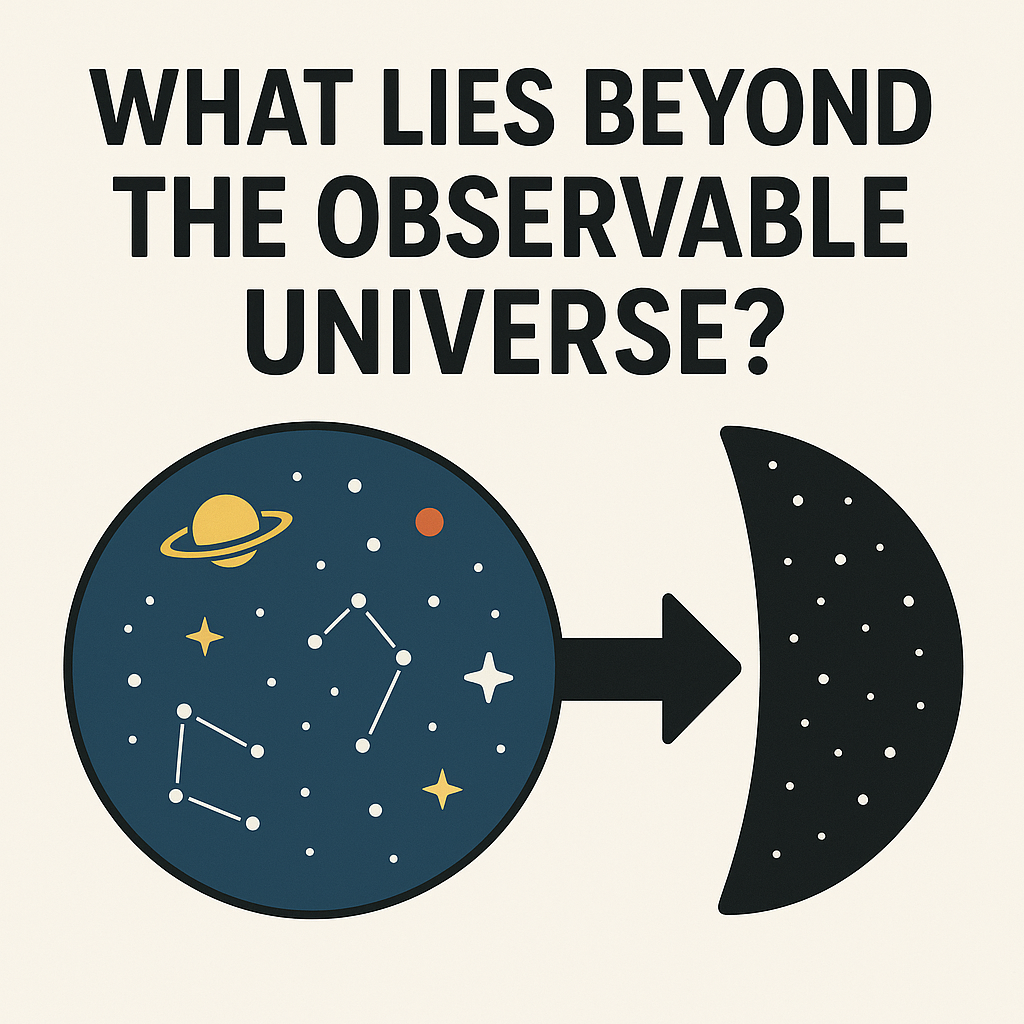
Every night, the sky looks like a vast archive—billions of galaxies written across billions of years. Yet there’s a boundary to what we can directly observe. Astronomers call it the observable universe. It’s not the end of everything; it’s the farthest distance light has had time to reach us since the beginning of the universe. Beyond that edge, the cosmos may continue—but whether it’s different, timeless, repeating, or fundamentally unknown depends on what the universe is doing on the largest scales.This blog post explores what might lie beyond the observable universe, why that boundary exists, and what modern cosmology suggests. Along the way, we’ll discuss related ideas like the cosmic microwave background, the Big Bang, cosmic expansion, the multiverse, and the limits of scientific knowledge. The goal isn’t to claim we know everything—it’s to understand what we can reasonably infer, what we can’t, and what questions keep pushing science forward.
The Observable Universe: Not “All of Space,” Just the Reach of Light
To understand the unknown beyond, we first need clarity on what “observable” means. The universe has expanded since the early hot, dense phase often associated with the Big Bang. Because space itself is stretching, the distance that light can travel to reach us changes over time. When we say the observable universe is about 46.5 billion light-years in radius, we’re describing the maximum distance from which light emitted since the early universe could have reached us by now.Important twist: this is not a simple snapshot of a static sphere. The expansion of space complicates the interpretation of distances. In practice, the observable universe is the set of regions of the cosmos where light (or other signals) has had enough time to reach us. If you were located elsewhere, your “observable” boundary would be different.
So What Lies Beyond?
The short, honest answer: we don’t know directly. But we can describe several credible possibilities, depending on the structure and behavior of the universe on scales larger than we can observe.
1) The Universe Could Continue—Same Physics, Same Pattern
The simplest possibility is that beyond the observable universe is more universe that follows the same laws of physics. Imagine our observable horizon as just a limitation of light travel time. If the universe is infinite (or enormously larger than what we can see), then what lies beyond is simply more of the same cosmos—more galaxies, more cosmic history, and more large-scale structure.This idea is popular because it fits how cosmology works: our observations of the large-scale universe appear statistically uniform on very large scales. In other words, the universe looks “roughly the same” in every direction we can observe, which suggests there might not be anything special at the boundary—only at the limits of what we can detect.
2) The Universe Might Be Finite—But Larger Than Our Horizon
Another possibility is that the universe is finite in size, but still larger than what we can observe. If the cosmos “wraps around” like the surface of a sphere (in a higher-dimensional sense), then the same region of space could appear more than once in our sky. In such models, the observable universe would eventually overlap with itself.Scientists look for patterns that might show this kind of cosmic topology—signatures like matching structures in different directions. So far, evidence is not definitive, but the hunt itself is a powerful example of how far researchers can reach even when the data is incomplete.
3) The Universe Could Have Different “Regions” or Dynamics
More speculative ideas suggest that beyond our horizon, the universe might behave differently. If cosmological parameters change over vast scales, or if the early universe underwent unusual events in other regions, then the distant “outside” might not mirror our observable past.However, any such claim becomes difficult to verify. Physics thrives on testable predictions, and the boundary of observation limits what we can directly compare. Still, theoretical models can be constrained by how they would affect observable quantities like the cosmic microwave background and the distribution of galaxies.
Cosmic Expansion: Why the Horizon Exists
One reason the observable universe has a boundary is tied to cosmic expansion. As the universe expands, distant regions can move away from us faster than light can reach them. This doesn’t necessarily mean the regions are “gone” forever in a literal sense—rather, signals from them can’t reach us before the present time.This is closely related to the concept of a cosmological horizon. In everyday terms, think of it as an “information boundary.” There are places whose light will never arrive at Earth no matter how long we wait. The exact behavior depends on whether the expansion accelerates, which appears to be the case due to dark energy.
The Cosmic Microwave Background: A Baby Photo with a Built-In Edge
One of the most important tools for studying the universe’s early state is the cosmic microwave background (CMB). This is the afterglow of the early universe—radiation released when electrons and protons combined into neutral atoms, allowing light to travel freely for the first time (often called recombination).The CMB forms a kind of “surface” we can observe from our location—an early snapshot. The CMB also reveals the limits of what we can infer. We observe fluctuations in temperature across the sky, reflecting density variations that later grew into galaxies and clusters.But beyond the observable universe, those early conditions could in principle continue in ways we can’t directly observe. Still, the existence of the CMB and its statistical patterns help confirm that our observable region is part of a much larger cosmic story.
Can We Ever Know What’s Beyond?
We may not be able to directly image “beyond” the horizon, but we can learn indirectly. The trick is to use physical laws and measurements we can make to infer what must be true beyond our reach.Here are some of the main indirect strategies:
Large-scale consistency tests: Does the universe look statistically uniform in all directions?
Geometry and curvature: The shape of space affects how light travels. Observations constrain whether the universe is open, flat, or closed.
Topology searches: If the universe wraps around, we might detect repeating patterns or correlations across the sky.
Structure formation: Galaxy clustering and gravitational lensing can reveal how matter is distributed over time.
Cosmological parameter consistency: Measurements of expansion rate, dark energy behavior, and matter density help constrain global models.
Even though the horizon limits direct observation, science can still place boundaries on plausible answers.
Enter Dark Energy: The Story’s “Outward Push”
Modern observations indicate that the universe’s expansion is accelerating, commonly attributed to dark energy. In simple terms, dark energy makes distant regions recede faster, and that affects the long-term evolution of the observable horizon.In the far future, fewer and fewer regions will remain visible, even conceptually, because the expansion increasingly prevents signals from arriving. That means the “beyond” that we can’t see might become even more inaccessible—not just today, but forever.Dark energy remains one of the biggest mysteries in physics. But its existence is crucial for thinking about what lies beyond the observable universe and whether it’s “out there” in a way that will ever become knowable to us.
Multiverse Ideas: Beyond, But Not Necessarily Observable
Some popular theories propose that our universe is just one “bubble” in a larger multiverse. Examples include:
Inflationary multiverse: Inflation could create many regions with different physical outcomes.
Many-worlds / quantum branching interpretations: In these views, different outcomes correspond to branches of a quantum state.
Brane-world scenarios: Our universe may be embedded in a higher-dimensional space with other branes.
These ideas can be fascinating, but they vary dramatically in whether they produce testable predictions. For AdSense-friendly science writing, it’s best to present multiverse theories as speculative possibilities rather than confirmed facts.Still, multiverse thinking is relevant because it reframes “beyond the observable universe” from “more space” to “possibly different realms or histories.” The common thread is that our observational reach is limited, and reality might extend farther than our instruments can sample.
Philosophical Boundaries: The Limits of Human Knowledge
Even in a universe where physics is perfectly consistent everywhere, knowledge has constraints. The observable universe isn’t a physical wall; it’s a boundary set by causality and the speed of light combined with cosmic expansion.So what lies beyond might be:
Physically present but information-protected by horizons.
Different in ways we can only infer from indirect evidence.
Unreachable even for hypothetical civilizations.
That doesn’t make the question meaningless. Instead, it turns cosmology into a study of inference under constraints—using math, physics, and careful measurement to map the unseen.
A Grounded Way to Imagine the “Beyond”
Here’s a creative but scientifically respectful analogy:Imagine you’re inside a lighthouse room during a storm. The windows show a limited area of the ocean—beyond the glass, you can’t see. But the ocean continues beyond the window. The tide and waves outside follow the same physics as the waves you can observe. You might deduce things about the deeper waters using patterns you see.Similarly, our cosmic “windows” show a region defined by time and light travel. The rest may follow the same laws, or it may have a different history or topology—but we can’t simply stare past the horizon. We infer.
What We Can Conclude (Without Overpromising)
So, what lies beyond the observable universe? The most responsible conclusion is:
It likely contains more universe than we can directly observe.
Whether it is infinite, finite but larger than our horizon, or topologically complex remains unknown.
The physics beyond could be the same or potentially different, but we need indirect evidence to support any claim.
Horizons limit direct observation, but they don’t fully eliminate knowledge—cosmology can still constrain global models.
Why This Question Matters
Ask any astronomer why they love this question and you’ll likely hear something like: because it forces the universe to reveal its rules. The observable universe is where we can gather data—temperature ripples in the CMB, the distribution of galaxies, the geometry of space. By understanding what we can measure, we learn what kinds of realities are possible.In a deeper sense, “beyond the observable universe” is also about humility and wonder. It reminds us that science is not only about answers—it’s about mapping the borders of what answers can be reached, and expanding those borders with every new observation.
Final Thought: The Horizon as a Doorway for Curiosity
The observable universe is our cosmic telescope’s maximum reach, not the end of reality. Beyond it may be more of everything: more galaxies, more structure, more cosmic history—or it might be a universe that loops back on itself, or even a realm where the standard assumptions break down.We can’t yet step over the horizon, but we can read its shape. We can test models, refine our measurements, and ask better questions. And in the process, we turn a boundary into a roadmap—guiding us toward understanding the largest scales of existence.If you’d like, I can also:
1) adjust this post to match your website tone (more casual or more academic),
2) add an FAQ section for SEO, or
3) rewrite for a specific word count target (e.g., 1200–1600 words).