Titan: The Alien World with Rivers, Lakes, and Seas
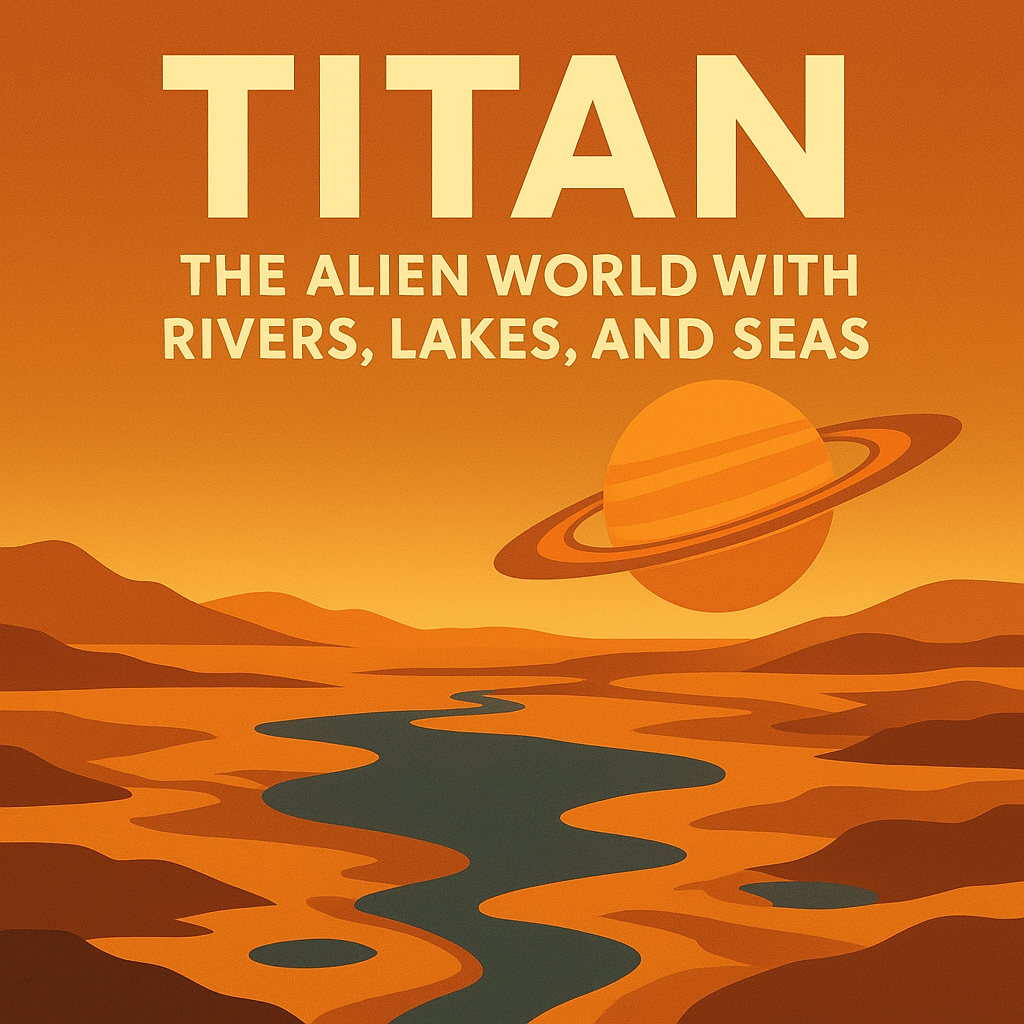
Saturn’s moon Titan has a way of rewriting the definition of “alien.” From a distance, it looks like a featureless orange dot in the outer solar system. But beneath its thick haze lies a complex landscape—one that includes rivers, lakes, and seas—not made of water, but of liquid hydrocarbons. Titan is often described as the most Earth-like world in the solar system because its weather, geology, and chemistry echo familiar processes. Yet everything about it is alien in the details: the air is different, the precipitation is different, and the “water cycle” is powered by methane instead of water.In this post, we’ll explore why Titan is so extraordinary, how scientists discovered its surface liquids, what these rivers and seas might mean for astrobiology, and what future missions hope to learn. Whether you’re fascinated by planetary science, astrobiology, or simply the beauty of worlds beyond Earth, Titan offers a story that is both scientifically valuable and endlessly captivating.
Where Titan Fits in the Solar System
Titan is the largest moon of Saturn and the second-largest moon in the solar system after Jupiter’s Ganymede. With a diameter of about 5,150 kilometers (over 3,200 miles), Titan is bigger than the planet Mercury. It orbits Saturn at a distance of roughly 1.2 million kilometers and experiences sunlight that is far weaker than what Earth receives—about 1% to 10% depending on the measurement.Despite that dimmer sunlight, Titan is warm enough to keep some liquids on its surface because of its thick atmosphere. Titan’s atmosphere traps heat efficiently, and its chemistry creates a persistent haze layer rich in organic molecules. In other words, Titan isn’t just a frozen moon—it’s a dynamic world with a long-running atmospheric engine.
Why Titan’s Atmosphere Looks Like an Orange Mystery
One of the first reasons Titan stands out is its dense atmosphere. It is primarily composed of nitrogen (N₂), like Earth’s, but with a significant amount of methane (CH₄) and other organic compounds. The methane and other gases interact with sunlight and high-energy particles, producing complex organic chemistry. Over time, this builds up the moon’s famous orange-brown haze.This atmospheric haze isn’t merely decorative—it affects how Titan’s surface is observed. Visible-light telescopes struggle to see through the thick cloud layer, which is why scientists have relied heavily on radar and infrared observations. Titan’s opacity is a barrier, but it also shields the surface chemistry from direct sunlight, potentially allowing delicate processes to persist longer.
Liquid on Titan: Not Water, but Hydrocarbons
When people hear “rivers and seas,” their instinct is to imagine water. Titan challenges that instinct. The liquids on Titan’s surface are mostly methane and ethane—simple hydrocarbon molecules that can exist as liquids under Titan’s cold conditions.Earth’s water cycle relies on evaporation, condensation, precipitation, and runoff. Titan has a parallel system, but with methane playing a role similar to water on Earth. Under Titan’s temperatures (around -290°C / -180°C depending on latitude and season), methane and ethane can remain liquid. When conditions allow, these hydrocarbons can evaporate, form clouds, and fall as precipitation.The result is a world where the “hydrology” is chemical and thermal, not just water-based. That makes Titan a natural laboratory for understanding how planetary systems might generate complex landscapes—even when the materials are unfamiliar.
The Evidence for Titan’s Rivers, Lakes, and Seas
So how do scientists know Titan truly has rivers and seas? The answer is a combination of spacecraft observations and radar mapping.The key breakthrough came with the Cassini mission, which orbited Saturn from 2004 to 2017. Cassini used radar instruments to penetrate Titan’s haze and map its surface. Radar is especially useful on Titan because it can detect differences in surface texture and composition. Smooth liquid surfaces reflect radar differently than rough land. That’s how scientists identified large, dark regions consistent with liquid methane/ethane.One of the most famous findings was the discovery of large hydrocarbon lakes concentrated near Titan’s poles. Later analyses linked drainage patterns and branching features to river-like systems, suggesting that liquid has flowed across Titan’s surface for extended periods.
What Do Titan’s “Seas” Look Like?
Titan’s seas are among its most striking features. The largest known sea system is often referred to as Kraken Mare, with similarly named seas such as Ligeia Mare. These basins appear darker than surrounding terrain in radar observations, which supports the idea that they are filled with liquid hydrocarbons.Unlike Earth’s oceans, Titan’s seas are not driven by tides caused primarily by the Moon. Saturn’s gravity and Titan’s orbital dynamics create tidal effects, but the details differ due to the moon’s environment and the nature of the liquid. Additionally, Titan’s atmosphere and precipitation cycles continue to shape the balance of liquid volume over time.Scientists also observe possible interactions at the coastline—areas where liquids meet land. On Earth, coasts carve, deposit, and reshape habitats. On Titan, the “coasts” likely undergo chemical and physical evolution as liquid hydrocarbons interact with surrounding organic-rich materials.
Titan’s Rivers: How Liquid Moves Across an Alien Surface
Titan’s rivers are often described as “dry” in the same way a riverbed might appear dry on Earth during drought. But Titan’s river systems are not simply fossil channels. Evidence suggests they are part of an active cycle, at least intermittently, where liquid flows during wetter periods or seasonal changes.Some of Titan’s river channels appear carved into darker and brighter terrains, implying erosion and transport processes. The landscape resembles an Earth-like drainage network in pattern, though the underlying materials are different. Instead of water cutting through rock, hydrocarbon liquids likely erode and transport organic-rich sediments.Scientists also consider the role of precipitation. Titan’s atmosphere can generate methane clouds. When those clouds become heavy enough, methane (and possibly ethane) can precipitate onto the surface. The liquid then flows downhill, forming rivers, filling lakes, and sustaining seas.
Seasonal Weather on Titan: A Methane-Driven Climate
Another reason Titan feels “Earth-like” is its weather. Titan experiences seasons because its axis tilt and Saturn’s orbital position change how sunlight—and thus atmospheric conditions—vary over time. During certain seasons, methane rain could become more frequent, while in other periods evaporation may dominate.Infrared observations and theoretical modeling support the idea that Titan’s methane cycle is active. That means Titan isn’t just a static moon with lakes—it’s a moving climate system.This matters because a functioning climate system can sustain geologic activity. Over long time scales, the cycling of liquids can shape dunes, cut channels, fill basins, and influence the formation and erosion of organic-rich deposits.
How Titan’s Surface is Shaped: Organic Sands, Cryovolcanism, and Erosion
Titan’s surface is a patchwork of different terrains: smooth plains, dune fields, impact craters, and mountainous regions. Many regions contain organic materials produced by atmospheric chemistry and then deposited on the surface.One of Titan’s distinctive features is its dunes, believed to be made of organic haze particles—sometimes described as “hydrocarbon sands.” Radar and near-infrared data suggest these dunes form wind patterns. If Titan has winds strong enough to move sand, it likely also has the conditions to transport dissolved or suspended materials when precipitation occurs.Some models also suggest a connection between liquid cycling and geological processes like cryovolcanism—volcanic activity involving icy materials rather than molten rock. Titan’s internal energy sources are debated, but the interplay between interior heat and surface chemistry could be crucial for understanding long-term evolution.
Could Titan Be Habitable? The Astrobiology Angle
Titan is not “Earth-like” in the sense of having breathable air or liquid water. However, astrobiology doesn’t require exactly Earth conditions. It asks a broader question: are the chemical ingredients and energy sources available for complex chemistry that could, in theory, support life?Titan has three notable ingredients often discussed in habitability research:
Complex organic molecules produced by atmospheric chemistry.
Liquid solvents in the form of methane and ethane, which could enable chemical reactions.
Potential energy sources such as sunlight-driven chemistry, magnetospheric particle interactions, and chemical gradients.
Could these processes lead to life? Some researchers propose “alternative biochemistry,” where life might use methane or other hydrocarbons rather than water. Others argue that while Titan’s chemistry is rich, confirming biology would be extremely challenging.Even without life, Titan is valuable because it shows how far-reaching and creative nature can be. Understanding how complex organics build up and evolve on Titan could help scientists interpret other worlds with thick atmospheres and methane-rich environments.
How Cassini Changed Our View of Titan
Before Cassini, Titan’s surface was largely speculative. After Cassini, we had radar maps, atmospheric measurements, and evidence for lakes and possibly river channels. Cassini also discovered that Titan has a global methane cycle, with seasonal changes that influence cloud formation and precipitation.The mission’s long-term presence in the Saturn system allowed scientists to watch Titan as a dynamic world. Instead of a single snapshot, Cassini offered a time-series understanding of weather and surface evolution.
Future Missions: What We Still Want to Know
Despite major discoveries, Titan still leaves many open questions, especially about its lakes and rivers:
How often do methane rains occur, and how do they vary by season and latitude?
What is the exact composition of the lakes (methane vs. ethane proportions, dissolved organics)?
How deep are the seas, and do they exchange materials with the surface?
What is happening chemically at the interface between liquid and land?
Are there signs of past or present habitability that we can detect remotely?
One of the most anticipated future efforts includes continued exploration by missions that can land on Titan or study it with more detailed instruments. Landing is especially important because it allows direct sampling of atmospheric composition, surface chemistry, and potentially the structure of dunes and river channels.Whether future missions focus on life detection, climate modeling, or geology, Titan’s rivers and seas provide the ideal “roadmap” for where to look and what to measure.
Why Titan’s Alien Seas Matter to Everyone
It’s easy to treat Titan as a fascinating object in a distant science documentary. But Titan’s rivers and lakes have broader significance.They help scientists answer big questions:
How do planets develop climates and hydrological cycles in environments unlike Earth?
How does complex chemistry evolve when the building blocks and temperatures are different?
What kinds of environments could support life—or at least life-like chemistry—outside our own planet?
How might we recognize similar worlds elsewhere in the universe?
As exoplanet studies accelerate, Titan becomes a reference point. When astronomers find distant worlds with thick atmospheres and possible methane signatures, Titan helps scientists interpret what those worlds might be like.
Conclusion: A World That Uses Methane to Create Landscapes
Titan is extraordinary because it turns an idea we associate with Earth—rivers, lakes, seas, and weather—into something entirely different in composition but similar in function. Saturn’s moon may be cold and shrouded in haze, but it hosts a methane-driven cycle that shapes the surface over time. Its hydrocarbon seas and river channels are not merely visual curiosities; they represent an ongoing system of evaporation, condensation, precipitation, and erosion.Whether or not Titan hosts life, it demonstrates that the universe can produce complex and beautiful environments through multiple pathways. Titan reminds us that “habitable” doesn’t always mean “like Earth.” Sometimes it means “like Earth in process,” even if the ingredients are wildly different.If you’re looking for an alien world with real, active geography—one where liquids flow and weather moves—Titan is one of the most compelling answers humanity has found.