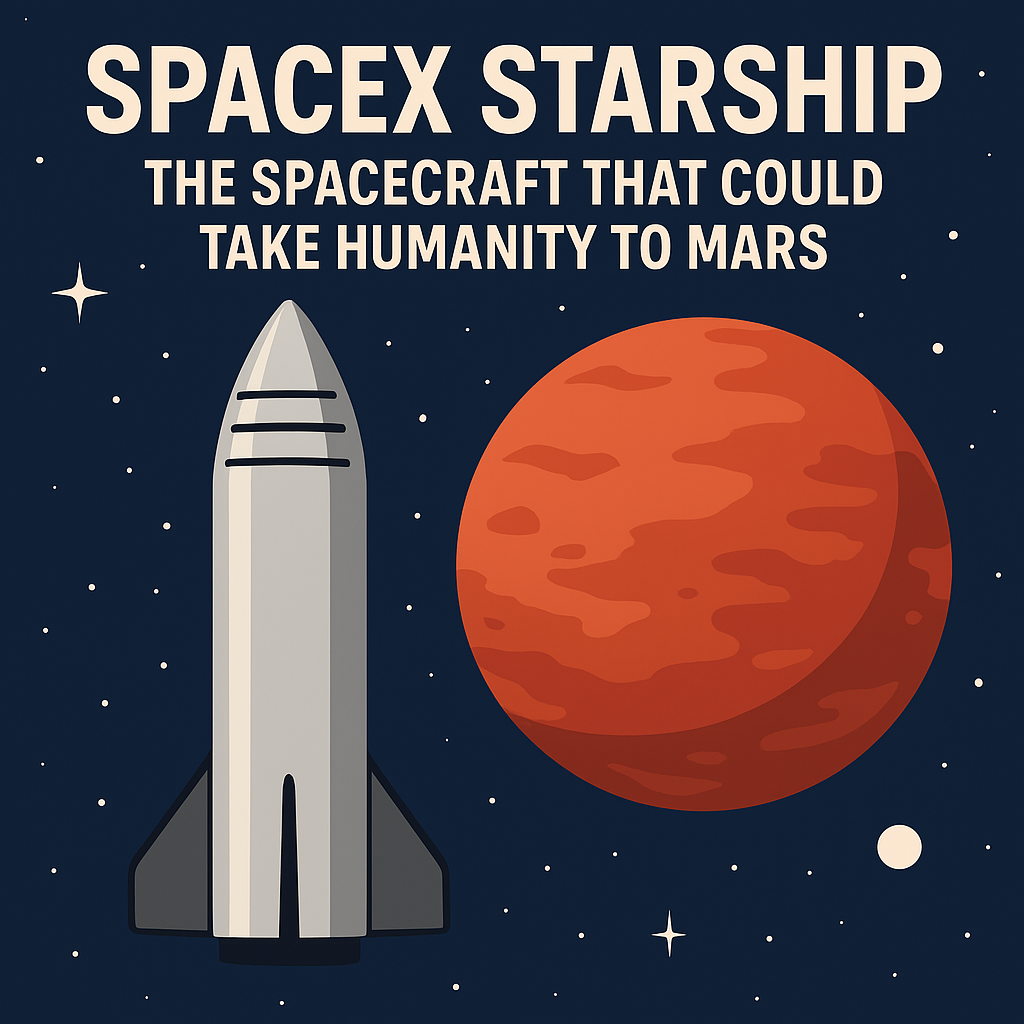
SpaceX Starship: The Spacecraft That Could Take Humanity to Mars
Few technologies have captured the public imagination quite like SpaceX’s Starship. Promising to carry humans beyond Earth and eventually to Mars, Starship isn’t just another rocket design—it’s a bold attempt to rethink how space travel works, from manufacturing to launch cadence to interplanetary operations. If successful, Starship could mark a turning point in humanity’s long-term future, turning “space exploration” from a series of rare missions into a sustainable, repeatable system.In this guide, we’ll explore what Starship is, why it’s different, how it might enable Mars missions, and what major engineering, safety, and logistical challenges still stand in the way. Along the way, we’ll cover related topics—reusability, propulsion, life support, orbital mechanics, space habitats, and more—so you can understand the full picture behind the mission to the Red Planet.
What Is SpaceX Starship?
Starship is a fully reusable spacecraft and launch system designed by SpaceX. It consists of two main parts: the Super Heavy booster and the Starship vehicle. The Super Heavy provides the initial thrust to escape Earth’s gravity, while Starship carries payloads and (eventually) crew to destinations such as the Moon and Mars.Unlike many rockets that are partially reusable or used only once, the Starship concept aims for rapid reusability. After launch, the booster and spacecraft are expected to return to Earth—using a combination of heat shielding, aerodynamic control, and landing systems—to be refurbished and flown again.This approach matters because the cost of access to space is one of the biggest barriers to building a future beyond Earth. If vehicles can be reused quickly and frequently, missions become more frequent and more economically feasible. That’s a core idea behind Starship.
Why Starship Could Be a Game-Changer for Mars
Mars is not simply “a longer trip.” It presents unique constraints: long travel times, radiation exposure, limited launch windows, and the need for reliable life support systems. To reach Mars at scale, a spacecraft must handle more than just launching—it must support sustained operations, and it must bring enough mass to make missions practical.Starship’s design targets these challenges with several key features:1) High payload capacity: Starship is intended to carry very large payloads compared to many existing launch systems.2) Reusability and scale: If reusability works as intended, SpaceX aims to reduce the cost per launch and build a “transportation infrastructure” for multiple trips.3) In-space versatility: Starship is designed to perform various mission profiles—such as lunar missions, cargo delivery, and crewed flights.4) Potential for in-situ resource utilization (ISRU): Mars missions may need fuel and consumables produced on-site. Starship’s architecture is meant to support a pathway toward that future.
The Big Idea: Building a Mars “Transportation System”
One of the most important concepts behind the Mars vision is that you don’t just need a single spacecraft. You need an entire system—multiple vehicles, multiple launches, and a plan for what happens to propellant, cargo, and crew when the mission arrives.For example, a mission may require delivering:• Crew habitats or habitat modules• Power generation systems• Life support supplies (or equipment needed to produce these locally)• Fuel and oxidizer• Scientific payloads and tools for long-term developmentInstead of relying entirely on supplies launched from Earth, the long-term goal is to leverage resources available on Mars. That’s where ISRU becomes crucial.
In-Situ Resource Utilization (ISRU): Turning Mars into a “Fuel Station”
ISRU refers to using local materials to produce usable resources. On Mars, one of the most promising feedstocks is its atmosphere, which contains carbon dioxide. There are planned processes that could convert CO2 into methane and oxygen—key ingredients for propellant.Producing fuel locally could reduce the number of cargo missions required from Earth. If Starship can deliver the equipment needed to start this process—such as chemical processing units and storage tanks—then future missions might become cheaper and more sustainable.ISRU is difficult and not guaranteed, but it’s a major reason why Starship’s design emphasizes the ability to move large amounts of cargo. Large payloads make it more feasible to bring the initial infrastructure that future missions can expand upon.
Starship’s Propulsion: Powerful Engines for Deep-Space Missions
Starship is powered by Raptor engines, which are designed to run on methane and oxygen. Methane has properties that make it attractive for interplanetary logistics and potential in-situ production. If Mars can supply the CO2 needed to generate methane, the fuel supply chain could eventually shift away from Earth.Propulsion is more than just getting off the launch pad. It affects:• Travel time and trajectory options• Fuel margins and reliability• How much payload can be delivered• The ability to capture into orbit and perform landing maneuversFor Mars missions, careful planning is essential. Rockets must escape Earth, travel through space, slow down enough to enter Mars orbit or begin descent, and then land with precision.
Reusability: The Economics of Reaching Another Planet
Reusability is often discussed as a cost-saving feature, but it’s also a mission-enabler. Mars is far away—each mission needs long preparation and a complex supply chain. If vehicles are only usable once, the number of required launches skyrockets.SpaceX aims to land both the booster and the spacecraft. This could allow for faster iteration: engines, heat shields, and systems can be refurbished and upgraded. Over time, that could create a “learning curve” where each mission improves performance and reliability.However, reusability comes with engineering challenges: heat shielding durability, structural integrity after repeated landings, engine wear, and maintaining reliability across many flight cycles.
Heat Management and Re-Entry: Surviving the Harshest Phase
One of the defining features of Starship is the need to survive re-entry and landing. During re-entry, the vehicle faces extreme heating due to atmospheric friction. Thermal protection becomes one of the most critical systems for safety.Starship uses a heat shield concept designed to handle intense temperatures during descent. The long-term goal is to make that system durable enough for repeated flights and efficient enough for rapid turnaround between missions.Even after mastering re-entry, landing is another challenge. In the atmosphere, wind, stability, and precise control affect touchdown accuracy. A vehicle that can repeatedly land safely increases mission flexibility and reduces costs.
Orbital Mechanics: Why Launch Windows Matter
Mars missions depend on orbital geometry. Earth and Mars move around the Sun, and the alignment determines when spacecraft can travel most efficiently. Launch windows are limited—typically on a schedule that allows missions to take advantage of favorable transfer trajectories.During a good launch window, a spacecraft can use less propellant and achieve a trajectory that reduces travel time or increases payload capability. If a mission misses the window, it might require waiting for the next opportunity, which can create delays and increase costs.
Crewed Mars Travel: The Human Challenges Behind the Engineering
Robots can tolerate more risk than humans, and they can operate with fewer comfort requirements. But crewed missions involve strict constraints on reliability and long-term habitability.Key concerns for a Mars-bound crew include:• Radiation exposure: Space radiation is a serious hazard. Missions may need shielding strategies and careful scheduling of transit phases.• Life support: Oxygen generation, carbon dioxide removal, water recycling, temperature control, and food supply must be stable for months.• Microgravity effects: Even before reaching Mars, astronauts experience weightlessness, which can affect muscles and bones.• Psychological wellbeing: Long-duration confinement requires reliable routines, privacy solutions, communication plans, and mental health support.• Emergency contingencies: Unlike on Earth, rescue may not be possible quickly. Systems must be designed with redundancy and safe failure modes.These human factors influence how spacecraft interior volume, power systems, and life support architecture must be designed. That’s why Starship’s role isn’t only about transportation—it’s part of a broader mission architecture.
Space Habitats: More Than a Ride
To live on Mars, crews likely need habitats that provide radiation shielding, pressure support, and thermal regulation. While Starship could transport people and materials, additional surface systems may be needed for long-term settlement.In many mission concepts, a structure might be transported to Mars first, then crewed later. Alternatively, habitats could be integrated with landing systems and expanded over time.Starship’s ability to carry large payloads could accelerate the timeline for establishing infrastructure—turning Mars from a destination into a place where humans can stay.
How Starship Fits Into a Broader Space Roadmap
Even before Mars, Starship could support missions around the Moon. Lunar objectives can serve as testbeds for deep-space operations, including:• Long-duration habitation experience• Cargo and propellant logistics• Surface operations and crew procedures• Navigation, landing, and docking techniquesMoon missions are also valuable for technology validation. Many lessons learned on the Moon translate directly to Mars operations—especially around landing safety, thermal management, and mission planning.
The Risks: What Could Still Go Wrong?
Building a spacecraft that can carry humans to Mars is one of the most demanding engineering challenges in history. There are risks at every layer—mechanical reliability, propulsion performance, software autonomy, and human safety.Some major challenges include:• Achieving consistent landing performance and structural durability• Ensuring heat shields and re-entry systems maintain integrity over multiple flights• Scaling manufacturing rapidly enough to support frequent missions• Meeting safety standards for crewed spaceflight• Solving life support and radiation protection for long missions• Developing ISRU in a way that reliably produces usable propellantThese risks don’t diminish Starship’s ambition—they highlight why the roadmap must include iterative testing, step-by-step validation, and careful mission design.
Why Starship Matters Beyond Mars
Even if Mars settlements take longer than hoped, Starship’s influence could extend across the entire space industry. A reusable, high-capacity system could change how satellites are launched, how scientific missions are delivered, and how future rockets are designed.Advances in manufacturing techniques, automation, engine development, and thermal protection can create benefits for many space applications. In many ways, the “Mars mission” also pushes technologies that can be used closer to home.
Conclusion: A Possible Future Where Mars Is Not Fantasy
SpaceX Starship is more than a spacecraft—it’s a concept for enabling a long-term human presence beyond Earth. With its design centered on reusability, large payload capacity, and a path toward scalable logistics, Starship could become a key component in the effort to send humans to Mars.The journey to Mars will require solving difficult problems: reliable propulsion, safe re-entry and landing, robust life support, effective radiation protection, and the complex challenge of producing resources on-site. But the core strategy—build transportation capability, develop infrastructure, and gradually expand mission capacity—aligns with how major engineering projects succeed.If Starship ultimately delivers, it could help transform Mars from a distant goal into a destination—and maybe, one day, into a second home.Have thoughts on Starship’s Mars mission, propulsion, or reusability? Share your perspective and keep exploring the technologies that may shape humanity’s next chapter in space.