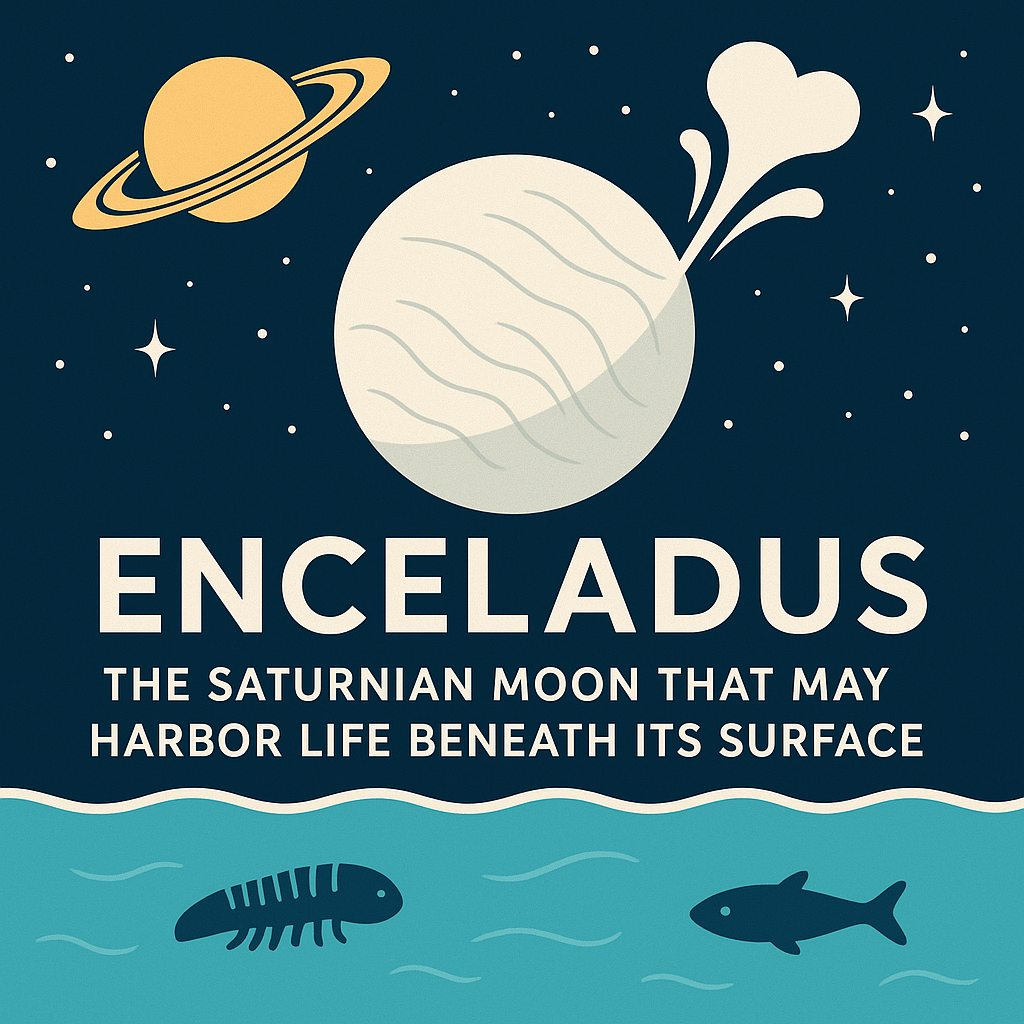
Enceladus: The Saturnian Moon That May Harbor Life Beneath Its Surface
Somewhere in the cold, distant reaches of Saturn’s system, a small moon is doing something extraordinary. Enceladus—only about 500 kilometers (310 miles) across—does not merely orbit its giant parent planet. It actively changes its surface, spewing plumes of icy material into space and hinting at a hidden ocean below. For scientists searching for life beyond Earth, Enceladus has become one of the most promising places in the Solar System.What makes Enceladus so compelling isn’t just its ice. It’s the combination of geology, chemistry, and energy—the ingredients often associated with habitable environments. In this article, we’ll explore the moon’s surprising features, why its ocean may be more than just frozen water, and how missions like Cassini have transformed Enceladus from an intriguing world into a serious candidate for extraterrestrial life.
Meet Enceladus: A Small Moon with Big Secrets
Enceladus is one of Saturn’s many moons, but it stands out due to its unusual activity. Most icy moons are relatively quiet, with surfaces that remain stable for billions of years. Enceladus, by contrast, shows signs of ongoing internal processes—fractures, heat, and dramatic plumes erupting from its south polar region.Its surface is largely covered by bright, reflective ice. Yet even this brightness is deceptive. Brightness suggests cleanliness, but Enceladus’s plumes imply that beneath the ice is a dynamic environment. The moon appears to have a long-lived heat source that keeps internal temperatures high enough for liquid water or warm brines to exist below the surface.
The Cassini Mission and the Discovery of Plumes
In 2005, NASA’s Cassini spacecraft made a landmark set of observations. During multiple flybys, Cassini detected water vapor and icy particles erupting from fissures near Enceladus’s south pole. The plumes—often referred to as “tiger stripes” due to their stripe-like appearance—shoot material hundreds of kilometers into space.These discoveries had profound implications. If Enceladus is actively releasing water and ice, it suggests that the moon has a reservoir beneath the surface. And if that subsurface region is in contact with energy-producing processes, it could create conditions suitable for microbial life.
The “Tiguar Stripes” and South Polar Heat
Enceladus’s south polar region contains prominent fractures known as tiger stripes. They are not just cracks. They appear to be pathways that allow material from the interior to escape.Even more fascinating, Cassini observed that these tiger stripes are associated with heat. Infrared measurements showed localized thermal emission—meaning some regions are significantly warmer than the rest of the moon. The heat is not easily explained by sunlight alone, especially because Enceladus is far from the Sun.Instead, scientists believe tidal forces—gravitational “stretching” caused by the moon’s orbit and its interactions with Saturn and other moons—are responsible for generating the internal energy. This ongoing energy could maintain a subsurface ocean and drive geologic activity.
Why Enceladus May Have a Subsurface Ocean
The strongest evidence for a subsurface ocean comes from the combination of:1) Active plumes: Material is escaping from below the surface.2) Heat at the south pole: Suggests ongoing internal processes.3) Gravity and orbit data: Indicate that the moon’s interior is differentiated and can support an ocean layer.4) Tidal interactions: Provide a plausible mechanism for maintaining warmth over long timescales.When scientists model the moon’s interior, they find that an ice shell could sit atop a liquid water layer. If the ocean is kept warm enough—and if pressure and composition allow it—liquid water could persist for millions or even billions of years.
Chemistry: More Than Just Water
If you’re looking for life, chemistry matters. Water alone isn’t enough, but water is a starting point. Cassini’s plume analyses revealed complex chemical signatures, including evidence suggesting a rich mixture of compounds.Notably, some measurements are consistent with the presence of salts and potentially reactive compounds. Enceladus’s environment may include water interacting with rock—often called water-rock interactions. This interaction can produce molecules that act as building blocks for biology.One of the most discussed indicators is the possible detection of hydrogen within the plume material. Hydrogen is important because it can be used by certain microorganisms on Earth as an energy source. While we cannot claim life has been found on Enceladus, these chemical hints strengthen the case that the moon’s ocean could be habitable.
Energy Sources: The Key to Habitability
Earth-based life doesn’t just need water and ingredients; it needs a way to generate energy. Enceladus might provide energy in several ways:Tidal heating: Saturn’s gravitational pull could flex the moon’s interior, creating friction and heat.Hydrothermal activity: If water contacts rock at the ocean floor, chemical reactions could create energy-rich gradients—similar to Earth’s deep-sea hydrothermal vents.Radiolysis: Natural radiation can split water molecules and create reactive chemistry, potentially contributing to biological precursors.In the search for life, these energy options matter because they can sustain environments even without sunlight.
Could Enceladus Support Life? What Scientists Mean by “Habitability”
It’s crucial to clarify a common misunderstanding: finding life and finding habitability are not the same. Scientists have not confirmed organisms on Enceladus. However, the moon has many features that make it a strong candidate.Habitability typically means an environment could potentially support life if suitable conditions persist, including:Liquid water (or at least periods of liquid water).Necessary chemical elements for biology.Energy sources to drive metabolic processes.Long-term stability so biology could develop over time.Enceladus checks many of these boxes. Its ocean appears likely, its chemistry appears promising, and internal heat may provide energy. That’s why researchers often refer to Enceladus as “one of the best targets” in the Solar System for life-detection missions.
Why Plumes Are a Game-Changer for Life Detection
One of the reasons Enceladus is so exciting for astrobiology is that its plumes act like a natural sampling system. Instead of drilling through ice, which is currently far beyond our technological capability, scientists can analyze plume material remotely.As icy particles and vapor rise and fall, instruments can measure their composition. If organisms—or organic molecules related to life—are present in the subsurface ocean, some of that material could be delivered to the surface and into space.This makes Enceladus potentially easier to study than worlds where the ocean is completely sealed under thick ice with no exchange of material.
Organic Molecules: Building Blocks Worth Watching
On Earth, organic molecules are the chemistry framework for life. In space, organic compounds can form through various processes—such as chemical reactions driven by energy, or by the breakdown and alteration of other compounds delivered by comets and space dust.In Enceladus’s case, if the subsurface environment contains the right ingredients and energy, organic compounds could survive or even accumulate. Instruments that detect specific types of molecules in the plumes could provide clues about whether the moon’s ocean is chemically complex enough for life.Even without direct “bio-signatures,” studying organics and their patterns helps scientists understand whether Enceladus is following a pathway toward biological chemistry.
The Icy Shell: A Barrier That Might Also Protect
Enceladus’s ocean is believed to be sealed beneath an ice shell. The thickness of that ice shell may vary, and fractures could act as channels. But in general, an ice shell provides an important function: it can protect the ocean from some external conditions.However, the same shell can complicate access. If you’re trying to detect life, you want exchange between the ocean and the outside. Enceladus’s plume activity suggests that exchange occurs, which may make it more accessible than other icy moons with less surface-geological communication.
Future Missions: Searching with Greater Precision
Although Cassini revolutionized our understanding of Enceladus, it was not designed as a dedicated life-detection mission. The next steps will likely involve:Higher-resolution measurements: Determining plume composition with greater sensitivity.Targeted sampling: Understanding how conditions change during different plume episodes.Better analysis of dust grains: Dust can carry information about the ocean’s chemistry.Assessing habitability in detail: Estimating temperature, salinity, and chemical gradients.One of the most anticipated ideas is a mission that can fly through or repeatedly sample the plumes, searching for signs of organic complexity or other indicators consistent with microbial life.
Comparisons: Enceladus and Europa and Mars
Enceladus isn’t the only target. Scientists are also studying other potentially habitable environments, including:Europa: Another ocean world with evidence of surface disruption and potential plumes.Mars: Not an ocean world today, but it may have had liquid water in the past, and underground regions could have sheltered ancient life.Titan: Saturn’s large moon with organic-rich chemistry and lakes of hydrocarbons, though the “liquid” environment is different from Earth-like water oceans.Each destination offers different evidence and challenges. Enceladus’s combination of active plumes and subsurface-ocean indicators gives it a special place in current astrobiology strategies.
Why This Matters: The Big Question of Life Elsewhere
Life is not just a biological mystery—it’s a scientific and philosophical one. If Enceladus truly supports life, it would transform our understanding of how common—or how rare—biological processes are in the universe.The implications would be enormous. It could suggest that life emerges when conditions are right, even far from Earth’s environment. It could also help us refine theories about the origin of life and the role of energy, chemistry, and time.Even if we never find organisms directly, studying Enceladus will still deepen our knowledge of planetary systems, ocean worlds, and the processes that shape habitability.
Conclusion: A World with Plumes, a Hidden Ocean, and Real Potential
Enceladus captivates scientists for a simple reason: it offers something we can’t ignore—evidence that a distant moon may be keeping liquid water alive beneath its ice. The plumes detected by Cassini, the heat from the south polar region, and the chemical hints seen in plume material all point to a dynamic subsurface environment. And in the search for life beyond Earth, such environments are exactly what we hope to find.Enceladus is still a mystery, but one with an unusually promising set of clues. It reminds us that the universe may be more alive—and more surprising—than we ever expected. As future missions take aim at the plumes and probe deeper into the moon’s chemical secrets, Enceladus could move from “possibly habitable” to “the place where we found something we can’t explain without biology.”If you found this article helpful, consider sharing it with other space enthusiasts. Enceladus may be far away, but its story is bringing the science of life-detection to the forefront of planetary exploration.