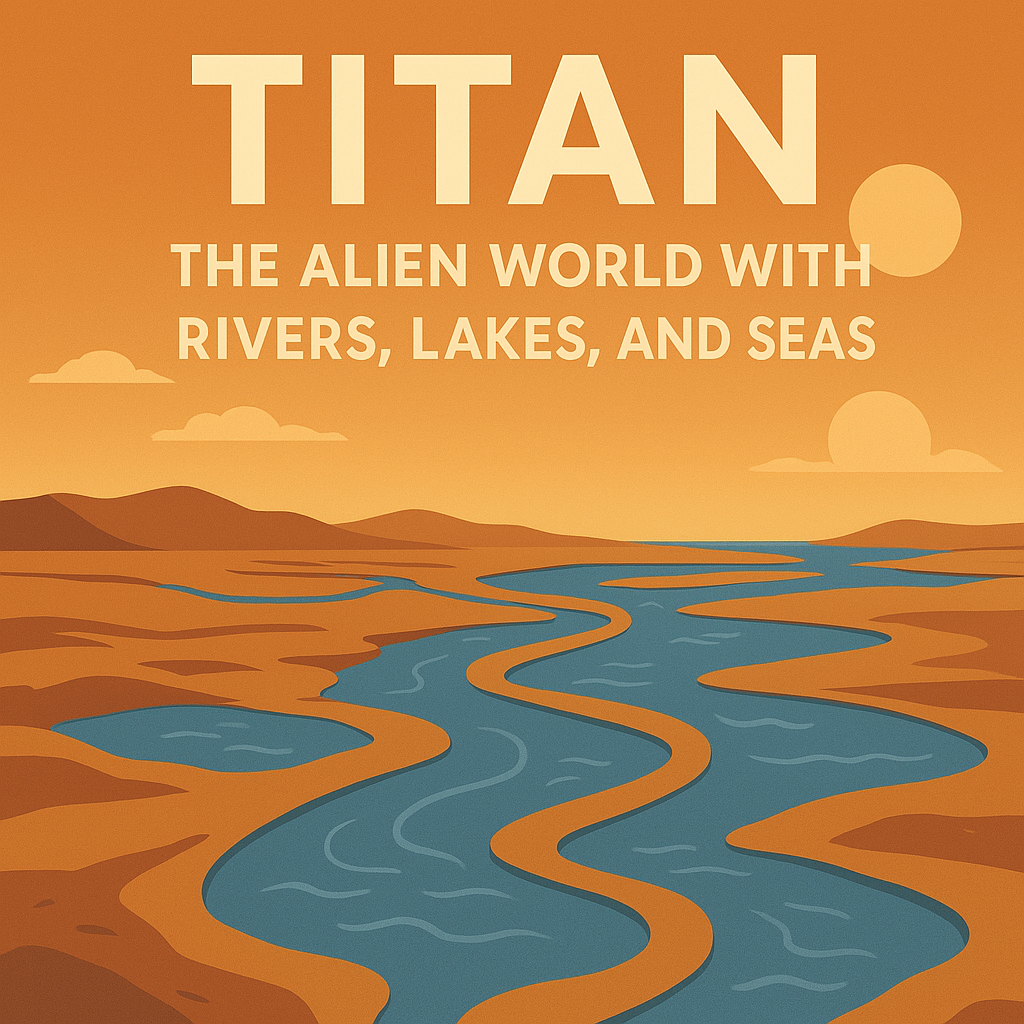
Titan: The Alien World with Rivers, Lakes, and Seas
Saturn’s moon Titan looks like an impossible place at first glance—an entire world wrapped in thick orange haze, where the sky can look hazy and the ground may feel slow and cold. Yet beneath that mystery lies one of the most fascinating landscapes ever discovered beyond Earth: Titan has rivers, lakes, and seas. Not water, but methane and ethane—liquids that behave like Earth’s water cycle in a drastically different environment.In this post, we’ll explore what makes Titan so special, how scientists know about its liquid hydrocarbon bodies, what those “rivers” and “seas” are made of, and why this distant world matters for astrobiology and planetary science.
Where Is Titan—and Why Does It Matter?
Titan is Saturn’s largest moon and one of the most intriguing targets in our solar system. It’s slightly larger than the planet Mercury and is the only moon in our solar system known to have a dense atmosphere. That atmosphere is dominated by nitrogen, with a significant amount of methane and other organic compounds.This combination—dense air plus methane chemistry—creates a natural laboratory. Titan experiences weather-like processes driven by the sun’s energy, including evaporation, cloud formation, and precipitation. On Earth, the story is told with water. On Titan, the story is told with methane and ethane.Studying Titan helps scientists understand planetary evolution, climate systems, and the range of environments where complex chemistry could arise. It also offers clues about how “prebiotic” chemistry might work outside Earth, potentially even leading to environments where life could exist—though Titan’s cold temperatures make that question both challenging and fascinating.
A World Hidden Under Orange Haze
If you could fly to Titan, you might not see a clear blue sky. Titan’s atmosphere is thick and hazy, with suspended organic particles that scatter sunlight and give the surface an orange-brown glow from afar. This haze can obscure details at visible wavelengths, but it doesn’t hide everything forever.Scientists use radar to “see through” the haze. Since radar can penetrate dense clouds, it reveals surface textures—like lakes, dunes, river channels, and possible shorelines. This is crucial, because Titan’s surface is not easily mapped with optical cameras due to the moon’s atmospheric opacity.The result is that Titan can look mysterious even to spacecraft—yet it still offers enough signals for scientists to reconstruct a surprisingly detailed geography of liquid bodies and moving materials.
What Are Titan’s Rivers, Lakes, and Seas Made Of?
On Titan, the liquids are mostly hydrocarbons. The most common are methane (CH4) and ethane (C2H6. In other words, Titan’s “water” is a mixture of organic molecules.Because Titan is so cold—around -290 degrees Fahrenheit (-179 degrees Celsius) at the surface—methane and ethane can exist as liquids rather than gases. That changes the entire planetary script. Over time, methane can move across Titan’s surface, collect in low-lying regions, and form long-lived seas and smaller lakes.So when you hear “Titan has rivers and seas,” you should picture a world where chemistry behaves like Earth’s hydrology but with different molecules and different temperatures. Instead of water flowing downhill, it’s methane and ethane shaping the land over long timescales.
How Do We Know Titan Has Lakes and Seas?
Scientists confirmed Titan’s surface liquids through a combination of radar observations and measurements of atmospheric methane.One of the most important missions for this discovery was NASA’s Cassini spacecraft, which orbited Saturn from 2004 to 2017. Cassini carried instruments that mapped Titan’s surface using radar, identifying dark areas that matched the behavior of liquid surfaces.Radar darkness often suggests a smooth, liquid surface because radar waves reflect differently off liquids than off rough terrain. The “dark patches” observed by Cassini were consistent with hydrocarbon lakes and seas.In addition, Cassini and ground-based telescopes helped scientists infer the presence of methane in Titan’s atmosphere. With methane present in the air and the evidence for stable liquid bodies on the ground, the pieces fit together: methane cycles through Titan’s environment much like water cycles on Earth.
The Titan Methane Cycle: Titan’s Version of Weather
Earth’s water cycle is powered by the Sun: evaporation occurs from oceans and lakes, water vapor rises, clouds form, and precipitation falls back to the surface. Titan’s methane cycle works in a similar way, though the details differ due to Titan’s colder climate and unique atmospheric chemistry.Here’s the simplified version of the process:
Evaporation: Methane evaporates from liquid reservoirs, especially near Titan’s surface liquid regions.
Transport: Methane vapor moves through Titan’s atmosphere.
Cloud formation: Methane condenses into clouds, which can gather and grow.
Precipitation: Methane (and possibly ethane) rains down, carving channels and feeding lakes and seas.
Surface flow and evaporation: The liquids spread in low areas, and over time, some evaporates again.
Scientists also observe evidence that Titan’s weather can be seasonal. Titan’s orbit around Saturn is long, and Titan experiences changes over time in sunlight and atmospheric dynamics, which likely influence where clouds form and where precipitation falls.
Geography of the Liquids: Seas, Lakes, and River Channels
What makes Titan’s liquid landscape especially captivating is its scale and structure. Titan contains large seas—some tens to hundreds of miles wide—along with smaller lakes scattered across the surface.In some regions, scientists have mapped what look like sinuous channels connected to lake basins, resembling river systems. Over time, precipitation events and surface runoff can erode the terrain, transporting material and carving pathways through the landscape.However, Titan’s rivers don’t work exactly like Earth’s water rivers. The viscosity, composition, and behavior of methane and ethane at Titan’s temperatures differ. Still, the overall “shape” of the process is similar: fluids follow gravity and collect in basins.
Why Are Titan’s “Shorelines” So Interesting?
On Earth, shorelines are dynamic—waves, currents, sediment, and storms continually reshape beaches and coastlines. On Titan, scientists don’t see waves like Earth’s familiar ocean surf. But they do see evidence that liquid boundaries exist between seas, lakes, and surrounding terrain.Radar data can reveal the contrast between smoother liquid surfaces and rougher, solid ground. This helps scientists identify where lakes end and where the terrain begins. Over long timescales, the “shoreline” could shift due to climate changes, evaporation, or the influx and outflow of liquids.This means Titan’s seas could be evolving—almost like slow-moving geological snapshots of methane storage and release.
Could Titan Have Life?
When people hear about Titan’s lakes and organic chemistry, they often ask about life. The question is exciting, but it’s also complex.Titan’s environment includes abundant organic molecules, a nitrogen-rich atmosphere, and a temperature range where methane and ethane can cycle. Scientists have found evidence that Titan’s upper atmosphere contains complex chemical reactions, producing a thick variety of organic compounds that may eventually settle onto the surface.Some researchers have suggested that Titan could potentially host life forms that rely on solvents and chemical pathways different from Earth-based biology. For example, rather than water-based biochemistry, hypothetical life might use liquid hydrocarbons as a working medium.That said, there is no direct evidence of life on Titan yet. Titan is also far from the liquid water temperatures and conditions that Earth life usually depends on. Still, Titan remains one of the best places in the solar system to study how far organic chemistry can go under alien conditions.
How Titan Compares to Earth (and Why the Comparison Isn’t Perfect)
Titan is often described as “Earth’s twin” because it has a thick atmosphere and a landscape shaped by liquids. But it’s not truly Earth-like. The most important differences include:
Liquid type: Earth’s liquids are mostly water; Titan’s are methane and ethane.
Temperature: Titan is extremely cold, which allows hydrocarbons to remain liquid.
Atmosphere: Titan’s air is nitrogen-rich, but it contains far more methane than Earth’s atmosphere.
Energy and chemistry: Chemical pathways and energy sources differ significantly due to temperature and atmospheric composition.
Even so, the similarities are striking enough to make Titan a powerful analogy for planetary processes: evaporation, condensation, precipitation, surface flow, and the slow reshaping of terrain.
What Cassini Revealed—and What We’re Still Learning
During its mission, Cassini returned a flood of data about Titan’s atmosphere and surface. It mapped potential landing regions and identified major liquid features. It also revealed that Titan’s methane isn’t just present—it’s being actively processed and cycled.Yet Titan still holds many questions. Scientists continue to refine estimates of:
The exact composition of lake mixtures (methane-dominant vs. ethane-rich variations).
The ages of surface features and how fast they change.
How seasonal shifts affect cloud formation and precipitation.
How organic materials move from the atmosphere to the ground and into liquid reservoirs.
New models, updated analyses of Cassini data, and future missions will keep improving our understanding. Titan is a world where “snapshot imaging” isn’t enough; it needs long-term study to understand cycles.
Why Titan’s Alien Seas Are Important for Planetary Science
Titan’s lakes and seas are not just a cool detail—they’re central to understanding how worlds work. They show that liquid reservoirs can exist in places far from the Sun’s warmth. They reveal that climates can develop even on moons with very different chemistry.Titan also teaches us about planetary habitability in a broader sense. Habitability doesn’t only mean “Earth-like conditions.” It can mean stability, chemical energy, complex chemistry, and environments where molecules interact over time.By studying Titan’s methane cycle and organic chemistry, researchers develop frameworks for evaluating other worlds—such as exoplanets and moons—where direct observation is limited but where climate and chemistry may still follow fundamental physical principles.
The Bottom Line: A “Water World” Made of Hydrocarbons
Titan is an astonishing example of how the universe can create landscapes that feel familiar in pattern but unfamiliar in substance. Its rivers, lakes, and seas—carved and maintained by methane and ethane—demonstrate that Earth-like processes can exist with totally different building blocks.Whether Titan ever hosts life remains an open question. But its active methane cycle, organic chemistry, and liquid bodies make it one of the most compelling targets for future exploration.If you’re fascinated by alien worlds, Titan offers a blend of wonder and science: storms and clouds overhead, liquid reservoirs on the ground, and a slow, cosmic weather system rewriting the moon’s surface day after day—only with hydrocarbons instead of water.
Suggested SEO Keywords (for context)
If you’re optimizing for search, this topic naturally aligns with keywords like: Titan methane cycle, Titan lakes and seas, Saturn moon rivers, hydrocarbon precipitation, Cassini Titan radar, and alien world habitability.Want to keep refining this post for AdSense approval? Share your target audience and any specific angles you want (astronomy basics, beginner-friendly science, or deeper chemistry/astrobiology), and I can tailor the wording and add internal sections accordingly.