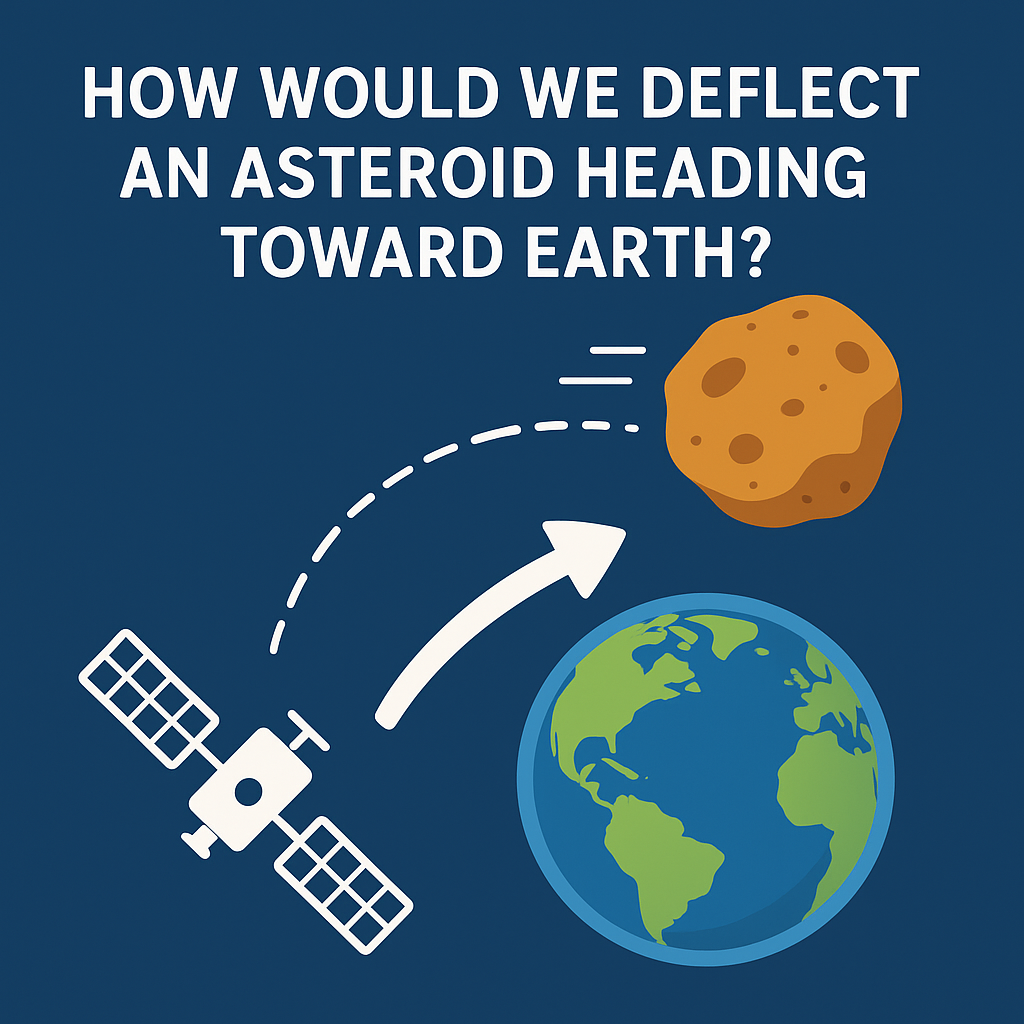
How Would We Deflect an Asteroid Heading Toward Earth?
If an asteroid ever truly threatens Earth, the question won’t just be “Can we stop it?” It will be “Can we change its course enough, early enough, and reliably enough to prevent impact?” Planetary defense is not science fiction—it’s an evolving set of engineering, physics, and international coordination strategies designed for one goal: keeping Earth safe from near-Earth objects (NEOs).In this post, we’ll explore the leading ways we can deflect an asteroid heading toward Earth, what it would take to detect and characterize a threat, and why “how” matters almost as much as “when.” We’ll also cover real missions, the logic behind different deflection methods, potential challenges, and how future improvements could make our planetary defense toolkit more robust.
1) First Things First: Detect, Track, and Confirm the Threat
Before any deflection method can be chosen, we must answer three questions with high confidence:
What is it? (size, shape, composition, rotation state)
Where is it? (precise position and orbit)
When will it arrive? (impact probability and uncertainty)
Most potentially hazardous asteroids are discovered by wide-field sky surveys using telescopes and automated detection pipelines. However, initial discoveries often come with large uncertainties. A newly found object might have a “best guess” orbit, but until we observe it over time—sometimes across many months or years—we can’t accurately predict whether it will pass safely or collide with Earth.That’s why “planetary defense” begins long before a spacecraft ever launches. It starts with observation campaigns, data sharing, and orbital refinement.
2) Why Deflection Depends on Timing and Distance
Deflection is constrained by one major factor: time.Think of an asteroid as a huge moving target. To meaningfully alter its path, we apply a small change in its velocity (often called delta-v) over a long period, or we apply a larger impulse quickly. The earlier we act, the easier it is to nudge the orbit so the asteroid misses Earth by a safe margin.If detection happens late—when the impact probability is high and the lead time is short—then only certain high-energy methods might be feasible. That’s why early detection and continuous tracking are so critical.
3) The Main Deflection Strategies
There are several ways to deflect an asteroid. The “best” choice depends on the asteroid’s properties, how much time we have, and how much maneuvering capability we can realistically deliver.
A) Kinetic Impact: “Smack It and Nudge It”
Kinetic impact is one of the most intuitive options: send a spacecraft to collide with the asteroid, transferring momentum and changing its trajectory.This approach doesn’t rely on complicated chemistry or explosive reactions. Instead, it uses the classic physics of momentum. But it’s not a guaranteed “guarantee” solution—success depends on factors like:
Asteroid composition and surface properties (hard rock vs. loosely bound regolith)
Rotation state (the spin can affect how evenly the momentum changes the orbit)
Impact geometry (where you hit matters)
How long you have (how much delta-v is achievable)
A famous real-world demonstration is NASA’s DART (Double Asteroid Redirection Test) mission. DART impacted the moonlet Dimorphos, successfully altering its orbit around the larger asteroid Didymos. While DART wasn’t aimed at an Earth impact threat, it proved that kinetic impact can work as a deflection tool.
B) Gravity Tractor: “Use Gentle Pull, Over Time”
If you have lots of time and want a method that’s less dependent on the asteroid’s surface properties, a gravity tractor concept can be compelling.The idea: place a spacecraft near the asteroid and use its own gravity to tug the asteroid gradually. This requires:
Proximity without colliding
Precise navigation and sustained station-keeping
Long lead time so the small gravitational effect accumulates
Gravity tractors could be useful for particularly tricky scenarios where impact is undesirable or where the asteroid is too fragile or has uncertain material behavior.
C) Ablation / Thermal Methods: “Heat It and Change Its Momentum”
Another deflection family focuses on changing the asteroid’s momentum by removing material.In general, you can heat the surface so it releases gas or ejects debris, and the ejection provides a reactive force—similar to how rockets work. Two related approaches include:
Laser ablation: a ground or space-based laser heats the surface, causing material to vaporize and escape
Thermal ablation: heating via another energy source to drive off material
These approaches can be powerful, but they also require high confidence in how the surface will respond to heating, and they demand robust energy systems. Also, the effectiveness depends heavily on surface composition and how much material can be ejected safely and predictably.
D) Mass Driver / “Cosmic Recycling”: Throw Something at It
Mass drivers are a proposed concept where a spacecraft (or tethered system) fires material toward the asteroid, using momentum transfer without needing to rely on chemical explosions.In simplified terms, the system accelerates projectiles and launches them into the asteroid to push it off course. This is conceptually similar to kinetic impact but with a key difference: it could allow many repeated pushes rather than one collision.Challenges include building the energy and storage needed for repeated launches, managing system reliability, and determining how the asteroid’s surface responds to repeated impacts.
E) Explosive Deflection: What About Nuclear Devices?
In popular media, nuclear devices often appear as the ultimate weapon against an asteroid. In real engineering discussions, nuclear options are typically framed around two approaches: detonation near the surface or stand-off to influence the asteroid’s material and trajectory.However, the planetary defense community treats nuclear deflection as complicated because it depends on:
Accurate timing
Predictable coupling between energy release and surface response
Risk of fragmentation (splitting into multiple hazards)
Political, legal, and safety considerations
That doesn’t mean nuclear is “off the table.” It means it requires careful modeling, credible testing, and an international consensus framework for use. If the threat is large and the timeline is extremely short, nuclear may be the only tool with sufficient energy margin.
4) Which Method Is Best? It Depends on the Threat
No single deflection method fits every asteroid. Consider an asteroid with a highly porous structure and a short warning time: kinetic impact might behave differently than predicted, and ablation might require more energy than available. Conversely, an asteroid with a known composition and abundant lead time might be ideal for gravity tractor or slow low-thrust approaches.In practice, decision-making would likely involve scenario analysis—running simulations to estimate orbital changes given uncertainties in size, spin, and composition.Here are a few general patterns:
Long lead time → slow methods (gravity tractor, targeted continuous ablation) become more feasible
Moderate lead time → kinetic impact or staged approaches may work well
Short lead time → high-energy, high-coupling options (including nuclear in some discussions) might be considered
5) Deflection Isn’t Just Physics—It’s Navigation and Risk Management
Even if physics says a method should work, engineering must make it real under uncertainty.Key practical challenges include:
Uncertain asteroid shape and mass: gravity and momentum calculations depend on it
Uncertain rotation: affects where and how force is applied
Trajectory planning under communication delays: spacecraft guidance must be robust
Planetary protection and debris risk: prevent contamination and manage fragmentation
That’s why missions often include characterization steps—either telescopic imaging and spectroscopy or spacecraft close approaches—before executing the deflection maneuver.
6) The Role of Space Missions and Demonstration Tests
Deflection capability improves through demonstration.Missions like DART help validate models of momentum transfer and the behavior of real asteroid surfaces. Future missions will likely expand our understanding across different asteroid types, sizes, and impact conditions.Another key component is improved ground observation—radar for near-Earth objects, spectroscopic measurements for composition clues, and constant orbit updates to reduce uncertainty.
7) Speed Matters: “Rapid Response” Infrastructure
If a high-probability impact scenario emerges, waiting months to decide would be too slow. Countries and agencies aim to build rapid-response systems: pre-approved mission designs, launch readiness planning, and international coordination protocols.In addition, there’s an operational question: Who decides? How quickly is data shared? How do multiple countries coordinate resources and public communication?Planetary defense is a global problem. That’s why organizations like the International Asteroid Warning Network (IAWN) and frameworks under the United Nations exist to coordinate detection, risk communication, and decision-making.
8) What Would an Actual Deflection Campaign Look Like?
Imagine detection of an asteroid with a non-zero impact probability years in advance. A realistic campaign might follow steps like these:
Confirm and refine orbit with continued observations
Characterize the asteroid using radar, spectroscopy, and light curves
Select a deflection approach using simulations that include uncertainty
Plan spacecraft design and trajectory with contingency options
Execute deflection (impact, ablation, or other method)
Monitor outcome with follow-up observations and update the trajectory model
After the maneuver, the asteroid’s orbit would be remeasured. The goal would be to confirm that Earth miss distance is increasing beyond a safe threshold.
9) The Biggest Obstacles (and How We Can Overcome Them)
What keeps planetary defense from being fully “plug-and-play”? Mainly uncertainty and logistics.Common obstacles include:
Late discovery: if we don’t find the asteroid early, options shrink
Limited knowledge of the target: small uncertainties can change predicted outcomes
Funding and coordination: sustaining preparedness is politically and economically challenging
Overcoming these issues requires investment in surveys, better asteroid databases, and more demonstration missions—plus international agreement on procedures for rapid action.
10) A Future of Layered Defense
The smartest approach to asteroid threats is not betting on a single method. It’s building a layered defense strategy:
Prevention through detection (finding threats early)
Characterization (knowing what we’re dealing with)
Multiple deflection options (matching technique to scenario)
Follow-up verification (confirming the miss distance)
Over time, as we gather more data from missions and improve modeling, deflection campaigns will become more predictable and faster to execute.
Conclusion: Deflecting an Asteroid Is Hard—but Not Impossible
So, how would we deflect an asteroid heading toward Earth? We’d start by detecting it early and refining its orbit, then choose a deflection strategy based on time, asteroid properties, and mission constraints. Options include kinetic impact, gravity tractors, ablation/thermal methods, mass drivers, and—under special circumstances—nuclear concepts.Planetary defense is ultimately about reducing risk, managing uncertainty, and acting quickly with the right tool for the job. It’s a demanding challenge, but it’s one we can prepare for now—through observation networks, simulation, international coordination, and real-world mission demonstrations.The most reassuring takeaway is this: we’ve already tested key ideas, and our knowledge is growing. If an asteroid threat ever becomes real, humanity’s best answer won’t be panic—it will be preparation, engineering, and science working together.